
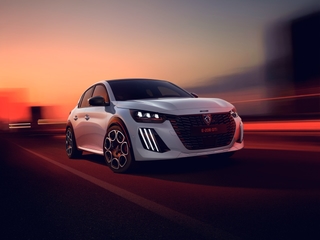


A year after the concept car was unveiled, the e-208 GTi has been officially revealed on the sidelines of the 24 Hours of Le Mans. For Peugeot, this car embodies modern electric performance – both dynamic and agile – following in the footsteps of its illustrious predecessor, the 205 GTi. Technically, the e-208 GTi incorporates elements from its Stellantis Group cousins. Peugeot has added an interior ambience, performance and the expertise of the engineers from the team developing the 9X8 for the World Endurance Championship.

e-208 GTi, the successor to a successful sports car
Fittingly, it is at Le Mans, to mark the centenary of its first appearance in the 24 Hours, that Peugeot is unveiling the e-208 GTi. It is never an easy task for a mainstream manufacturer to revamp a car whose commercial success and history have left their mark on so many generations. With the launch of the unexpected 205 GTi in 1984, Peugeot had created one of the most fun cars to drive – light and agile, responsive and accessible – with over 330,000 units produced. Today, it has become a first-rate ‘youngtimer’, sought-after and collected.
Subsequently, the 206 RC and 207 RC, followed by the 208 GTi, carried on this momentum without achieving the same success or popularity as the original model. To continue the GTi story in 2026, the little lioness must be electrified; it is already the best-performing electric city car on the market.

Outstanding achievements
In line with the group’s strategy, the e-208 GTi therefore features the same technical specifications as its cousins, the Lancia Ypsilon HF and the Abarth 600e. Namely, the M4+ electric motor (manufactured in Tremery, in the Moselle region) which produces 281 hp and 345 Nm of torque. Its power-to-weight ratio is stated as 5.5 kg/hp and its acceleration is the best among Stellantis’ small cars. It goes from 0 to 100 km/h in 5.5 seconds (compared to 5.6 seconds for the Lancia), a remarkable figure. Its top speed is electronically limited to 180 km/h. Is this a consequence of the recently unveiled FastLane 2030 plan? As Peugeot is one of the group’s four major brands, it seems logical to allocate the best specifications to its models.

Developed in collaboration with Peugeot Sport engineers
The development focused primarily on driving pleasure. Peugeot Sport engineers were called upon to optimise the performance of the e-208 GTi. According to Christophe Auriault, the project manager: “The work on the engine’s electronic control draws directly on the expertise gained in motorsport and is transferred from the track to the road. The skills used in developing the e-208 GTi are the same as those employed when working on the 9X8”, i.e. the Peugeot hypercar competing in the World Endurance Championship (WEC). As a result, the little lioness accelerates from 80 to 120 km/h in 3.2 seconds and takes less than 6 seconds to cover 1,000 metres from a standing start.
Furthermore, experience gained from motorsport enables better thermal management of the batteries; the cooling system prevents any loss of power and delivers consistent performance even under demanding conditions. Nipping along winding mountain roads at a brisk pace is the ‘GTi spirit’ that Peugeot wanted to preserve, even in a fully electric model. It remains to be seen how it performs on the road.

Redesigned chassis
Like the Lancia Ypsilon HF, the Abarth 600e or the Mokka GSE, the Peugeot e-208 GTi is a front-wheel drive with a limited-slip differential, and its 54 kWh battery (51 kWh net) provides a range of 352 km (WLTP) (up to 375 km with low-rolling-resistance tyres). Charging times aren’t the fastest in its class: expect 30 minutes to charge from 20% to 80%, as the maximum permitted power does not exceed 100 kW. Compared to the e-208, the chassis is lowered by 2.5 cm, the track widths are slightly wider and the rear suspension features an anti-roll bar to maintain full stability during fast cornering. Note that regenerative braking is disabled in Sport mode to deliver the driving experience expected of such a sports car.

Cockpit with a sporty feel
Inside, the e-208 GTi features an interior inspired by the legendary 205 GTi, with a sporty ambience dominated by red and black. The exclusive, supportive and comfortable seats strengthen the connection between the driver and the car. The bespoke steering wheel and optimised steering deliver a more direct and dynamic driving experience. The experience is enhanced by a digital GTi interface, customisable ambient lighting and an immersive sound system. The car combines high-end equipment, advanced connected services and practical charging solutions for sustainable everyday use, including a route planner that optimises range and charging. Finally, it features a V2L (vehicle-to-load) function to power external devices.

Starting price over €40,000
Starting price from €42,900 (excluding the eco-bonus), the e-208 GTi costs €500 more than a Lancia Ypsilon HF (which is less prestigious) and €700 more than the Alpine A290 GTS (which has less power: 220 hp). Orders are now open, yet competition in this emerging segment is only just beginning, as we must also factor in the VW ID Polo GTi, the Cupra Raval and the Mini Cooper SE.