
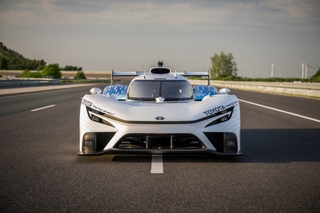




Renowned as a technological testing ground for car manufacturers, the Le Mans 24 Hours circuit is hosting the Toyota Racing TR LH2 prototype, which runs directly on liquid hydrogen. Several demonstration laps are being held to mark the start of the famous endurance race. Toyota is thus demonstrating that a hydrogen combustion engine can deliver thrills and performance similar to those of a conventional internal combustion engine, whilst limiting CO2 emissions. Ultimately, Toyota’s strategy is to develop hydrogen technology in motor racing, but above all in industry, heavy goods vehicles and commercial vehicles.

Toyota: a pioneer in hydrogen
It is not yet a category in the World Endurance Championship (WEC), but hydrogen is set to become one of the fuels of the future in motor racing. For several years now, Toyota has established itself as a pioneer in this complex but promising technology. To mark the start of the 24 Hours of Le Mans, Toyota Racing will be putting its TR LH2 prototype (an optimised version of the H2 Racing concept unveiled in 2023) through its paces in front of the public on the Circuit de la Sarthe. At the wheel on Thursday 11 June will be driver Kazuki Nakajima, a three-time winner of the race. This full-scale demonstration thus validates the strategy of the Japanese manufacturer, which is investing heavily in hydrogen as a fuel that does not emit CO2 into the atmosphere.

Ultra-low-temperature liquid hydrogen
The technology developed by Toyota is based on the same chassis as the TR010 Hybrid hypercar that competed in the Le Mans race, except that the TR LH2 Racing prototype uses liquid hydrogen (LH2) stored at very low temperatures and burned in a hydrogen-compatible internal combustion engine, which therefore replaces petrol. It does not, therefore, operate like a fuel cell (where gaseous hydrogen is used to generate electricity to power a motor), as in the Toyota Mirai.
This is therefore a rare innovation in motorsport. Unlike a few projects such as the Alpine Alpenglow, which use hydrogen in its gaseous state, Toyota has managed to inject this fuel directly into an internal combustion engine. The advantage of liquid hydrogen is its higher volumetric energy density compared to compressed gaseous hydrogen. Put simply, this fuel is more compact and can be stored more efficiently in an endurance racing car where space is limited. On the other hand, liquid hydrogen requires complex cryogenic tanks (cooling to very low temperatures) and careful management of evaporation.

In development since 2021
Toyota appears to have found a solution to these technical challenges. The TR LH2 Racing’s laps of the Le Mans circuit should showcase this technology to the public, with particular attention being paid to the engine’s sound and its performance on the track.
Toyota began developing hydrogen-powered engines in 2021 with the Corolla GR H2 Concept, a passenger car, competing in the Japanese Super Taikyu Championship. A GR Yaris H2 then caused a sensation during demonstration runs on rally tracks. The adaptation for an endurance car dates back to 2023. Will we ever see this technology in official racing? That is certainly the hope of the ACO (Automobile Club de l’Ouest) and the Mission H24 project, which could introduce a hydrogen category to the 2028 Le Mans 24 Hours. With zero CO2 emissions during operation, the hydrogen engine is one of the future solutions for a more sustainable motorsport, and Toyota is the manufacturer furthest ahead in this field. This TR LH2 concept aims to explore low-carbon solutions for motorsport whilst maintaining the passion for the sport.

For industry and heavy goods vehicles
On an industrial scale, the Japanese giant hopes to produce variants of direct hydrogen combustion for certain machine tools, energy infrastructure, heavy goods vehicles and commercial vehicles. Passenger cars are not yet a priority, given the lack of infrastructure and storage challenges. This will likely take its first steps in motorsport before we see the first mass-production applications in our everyday cars. Toyota is therefore proving bold and ambitious, as its investments are also focused on refuelling infrastructure: moving towards faster and less expensive stations.