



In the history of European motoring, few models have managed to stand the test of time without losing their relevance. The Iso Isetta is one of them. Born in a Europe in the midst of reconstruction, it became a symbol of accessible mobility and is now making a comeback in a greener form with the Microlino. The latter stands out as a contemporary reinterpretation of a concept that is over 70 years old.

The Isetta, an icon of a Europe in the process of reconstruction
To understand the significance of the Microlino, we need to go back to the early 1950s. The Isetta was launched in 1953 by Iso, an Italian company originally specialising in scooters and small vehicles. The context at the time was very specific: Europe was emerging from the Second World War, purchasing power was limited and infrastructure was still fragile. The conventional car remained out of reach for a large part of the population.
It is against this backdrop that the Isetta stands out as a radically different solution. Measuring around 2.30 metres in length and weighing barely 350 kg, it features a unique design: a front door that spans the entire front of the vehicle, allowing direct access to the interior. Inside, two passengers sit side by side in a compact but optimised space. Its single-cylinder engine, derived from a motorbike, produces a modest power output of around 12 horsepower, with a top speed of nearly 85 km/h.


But what really made the Isetta a success was its large-scale production under licence, notably by BMW. It was an instant hit. Produced between 1955 and 1962, more than 160,000 Isettas were sold in Germany alone – an impressive figure for the time. Globally, across all versions, production exceeded 300,000 units. With its single-cylinder engine derived from a motorbike (often around 250 to 300 cc), its extremely low fuel consumption and its ultra-compact size (around 2.3 metres long), it became the embodiment of accessible, practical and ingenious mobility.
What’s more, the Isetta literally saved BMW from bankruptcy. It enabled the brand to survive a critical period and gradually finance its shift towards more ambitious models. Rarely has such an unconventional car played such a pivotal role in the history of a car manufacturer.

Why this concept still resonates today
More than 70 years on, the context has changed, but some of the issues remain strikingly similar. Urban congestion, a shortage of parking spaces and the overall cost of transport are prompting a rethink of the very concept of the car.
In major European cities, the average size of vehicles is increasingly at odds with actual usage patterns. The majority of journeys are made alone, over short distances, in congested areas. It was precisely in this context that the Isetta proved its worth in the 1950s.

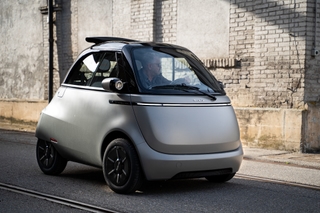
It is on this basis that the Microlino was conceived. Developed by the Swiss company Micro Mobility Systems, it explicitly draws on the design cues of the Isetta.
The visual similarities are striking: front-opening door, rounded silhouette, ultra-compact size. At around 2.50 metres long, the Microlino stays true to the same philosophy as its predecessor. It also retains the two-seater layout and the concept of a vehicle designed exclusively for urban use. Above all, the highly original front-opening door has been retained to evoke the spirit of the Isetta. Yet, despite this quadricycle’s XS dimensions, it still boasts a 230-litre boot.

A transformation shaped by the 21st century
Where the Microlino differs radically from the Isetta is in terms of technology. Gone is the single-cylinder combustion engine: the Microlino is 100% electric. It offers several battery configurations, with a range of up to around 230 km depending on the version, and a top speed of around 90 km/h.

These figures clearly position it as an urban vehicle, incapable of competing with a traditional car on the motorway. But that is precisely where its strength lies: it does not set out to do everything, but simply to serve a specific purpose effectively.
Another major development is safety and design. Unlike the Isetta, the Microlino meets modern standards in terms of structure, braking and equipment.

An icon reimagined, not copied
With the Microlino, the Isetta isn’t simply being brought back as it was. It has been reinterpreted, adapted and placed in a new context, and is part of an emotional journey.
In the 1950s, the Isetta was the answer to a Europe in the process of rebuilding. In 2026, the Microlino is the answer to a changing urban mobility landscape. Between the two, there is a common thread: offering a solution that is simple, compact and in tune with its times. Some ideas never go out of fashion; they simply evolve.