




ACC is entering a new phase in its development. The European manufacturer of electric vehicle batteries has announced the appointment of Allan Swan as Chief Executive Officer with effect from 1 May 2026, with a clear mandate: to accelerate industrial ramp-up in a challenging environment. This change in leadership comes as the group faces operational difficulties at its site in the Hauts-de-France region and increased pressure from Asian competitors.

A change of leadership at a critical juncture
ACC is changing leadership at a pivotal moment in its industrial development. Indeed, the joint venture (between Stellantis, Mercedes and TotalEnergies) has so far failed to turn its ambition into a tangible industrial reality.
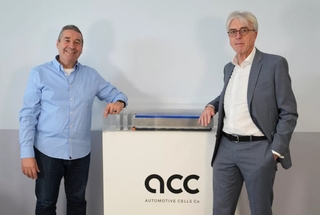
And to achieve its goals, the company has decided to appoint a new leader. The man chosen for the role, Allan Swan, is no ordinary figure: he was previously head of Panasonic Energy USA, where he oversaw the ramp-up of two gigafactories supplying Tesla, amongst others. His expertise is directly relevant to ACC’s current challenge: moving from industrial promise to controlled mass production.
Allan Swan said he was “honoured by the trust placed in me by ACC’s shareholders and excited to be joining the company at such a crucial time for the electric vehicle industry.”

Yann Vincent, the project’s architect, is stepping down
This change also marks the end of an era. Allan Swan is taking over from Yann Vincent, who is retiring after six years at the helm of the company, having been there since its inception.
Under his leadership, ACC laid the foundations for the European battery industry: launching the first gigafactory, establishing an industrial ecosystem and developing clean technologies through its R&D centre in Bordeaux-Bruges.
But the role of a builder is not that of large-scale industrial production. The handover precisely reflects this shift: after the construction phase comes the industrial production phase.

A ramp-up that proved more difficult than expected
That is the crux of the matter. ACC itself acknowledged last February that ramping up production at its plant in northern France is “taking longer and costing more than anticipated”.
In this industry, everything hinges on process control: production volumes, scrap rates and line stability. Yet it is precisely these factors that determine profitability.
The group nevertheless reports progress: module production has doubled in the space of a few months and the rate of unusable batteries is falling. However, these advances are still insufficient to fully stabilise the business model.

Increasing external pressure
These internal difficulties are occurring against the backdrop of a tighter market.
On the one hand, demand for electric vehicles continues to grow, albeit at a slower pace than expected. On the other hand, European manufacturers – ACC’s main customers – are taking a more cautious approach to their investments.
Above all, competition from Asia is a major challenge. Companies such as BYD and CATL largely dominate global battery production, benefiting from low costs and a high level of industrial maturity. Against this backdrop, ACC must both catch up in terms of industrial capacity and secure its markets.
A strategic project for European sovereignty
Despite the challenges, the stakes remain high: ACC is at the heart of the European strategy for industrial sovereignty.
Today, almost all the batteries used in Europe are produced by Asian manufacturers. ACC’s ambition is precisely to reduce this dependence. The joint venture’s new CEO is confident on this point: “I look forward to working with the ACC teams to accelerate growth, expand our manufacturing capacity, and support Europe’s ambition for clean, competitive and energy-independent mobility.”
But this ambition comes at a cost. The group has, in fact, put its plans for new factories in Germany and Italy on hold
A new, more demanding phase
The appointment of Allan Swan appears to be a logical choice. He is taking over a well-structured but vulnerable company that is making its own energy choices, as ACC has chosen to focus on the NMC (nickel-manganese-cobalt) segment, a battery chemistry valued for its energy density but more expensive than LFP (lithium-iron-phosphate).

That is precisely what this new phase is all about: turning an industrial ambition into a sustainable economic reality. And it is precisely in this area that the new leader is expected to deliver.