

Four years after acquiring ALPINA, BMW has finally unveiled its concrete vision for the brand’s future. Unveiled at the 2026 Concorso d’Eleganza Villa d’Este, the BMW ALPINA Vision is more than just a concept car: it outlines the new identity of a brand set to position itself between BMW and Rolls-Royce, with a distinctive blend of performance, comfort and understated luxury at its core.

The BMW ALPINA Vision seems to be taking a different approach.
BMW has probably just answered a question that many enthusiasts have been asking themselves for several years: what will the ALPINA of the future actually look like?
Since the announcement of BMW’s takeover of the German manufacturer in 2022, followed by its official integration into the group in 2026, the brand’s future has been the subject of much speculation. Some feared a gradual dilution of its identity, whilst others were already imagining it as nothing more than a luxury version of existing BMW models.
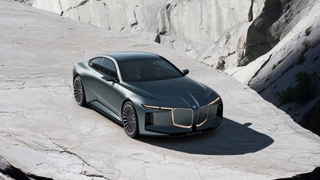
We’ve known more since 18 May 2026, at the Villa d’Este Concours d’Élégance. A concept car was unveiled, taking the form of an imposing coupé measuring 5.20 metres in length. Its silhouette is reminiscent in some respects of the 8 Series, which is set to be discontinued with no real replacement announced as yet.

More than just a top-of-the-range BMW: a new collaboration between BMW and Rolls-Royce
The ambition is now much clearer than before: BMW wants to position ALPINA as a brand that bridges the gap between its traditional premium models and Rolls-Royce.
Oliver Viellechner, Head of BMW ALPINA, said: “BMW ALPINA occupies a unique position within our portfolio, between BMW and Rolls-Royce, at a time when we are seeing growing potential in the high-end luxury segment.”

The positioning is particularly interesting. On the one hand, BMW already has top-of-the-range models such as the 7 Series and X7. On the other, Rolls-Royce remains positioned in an ultra-luxury segment where the passenger experience far outweighs the driving experience.
ALPINA will now have to occupy this middle ground: more exclusive than a standard BMW, yet more focused on driving pleasure than a Rolls-Royce. This also indirectly brings the German group’s strategy closer to that of Mercedes with Maybach.
A design that revives several of the brand’s historic design elements
Visually, BMW has not sought to create a complete break with the past; on the contrary, the BMW ALPINA Vision is full of historical references.
The long bonnet, the elongated roofline, the low-slung proportions and the famous shark nose are immediately reminiscent of certain BMWs from the 1970s, particularly the early E24 6 Series models.

The famous ALPINA 20-spoke alloy wheels are also making a comeback, as are the side trim strips that have featured on the brand’s models since the 1970s.
But bear in mind, this is 2026, so the approach is much more modern. Decorative lines are now integrated directly beneath the paintwork, the exterior surfaces feature carefully crafted contrasts between dark metallic finishes and lighter shades – likely inspired by details from historic models such as the BMW 507 – and the light signatures have become extremely slim.

Maximilian Missoni, Head of Design at BMW ALPINA, explains this philosophy: “Every detail reflects a genuine quest for substance, whether in terms of engineering, materials or the story the vehicle tells.” The idea, therefore, is not to pile on ostentatious features, but rather to offer a more understated form of luxury.

An interior designed more for grand touring than as a showcase for technology
This philosophy is also evident inside the car, where the cabin is designed with a clear focus on comfort and long-distance driving. The interior architecture is based on clearly defined spaces, with a distinct separation between the different zones, rather than a fully digitalised or uniform design. It features the new BMW Panoramic iDrive interface from the Neue Klasse range, which combines a head-up display at the base of the windscreen with a central screen that spans the full width of the dashboard, creating a sense of visual continuity.

The coupé’s generous 5.20-metre wheelbase allows for a genuine four-seater layout, with particular attention paid to the rear seats, which are designed for long journeys rather than occasional use. The front seats, which are more enveloping, follow the same low, stretched design philosophy, in keeping with the vehicle’s overall silhouette. The materials follow the same approach, featuring full-grain leather sourced from suppliers in the Alpine region and metal elements finished in a style inspired by watchmaking, combining satin and polished surfaces.

Certain features complement this ensemble in a more specific way, such as the integration at the rear of the centre console of a glass water bottle accompanied by BMW ALPINA crystal glasses, which are automatically deployed. This feature is consistent with the concept’s design philosophy, in which functional elements are treated with a particular level of finish. The press release links these features to a long-standing brand philosophy, inherited from Burkard Bovensiepen, according to which in-car comfort is directly linked to the driver’s ability to concentrate and perform.

A V8 under the bonnet, but the door is open to electrification
Beneath its massive bonnet, the BMW ALPINA Vision currently suggests a V8 engine, which is being touted as the benchmark internal combustion engine for this concept. BMW is, however, deliberately keeping a low profile: no official figures on power or performance have been released.
And this is precisely where this concept really comes into its own, as it is, above all, a design study that marks the start of a new chapter for ALPINA within the BMW Group.

In this context, it is hard to imagine a future model in this segment without some form of hybridisation, or even a shift towards all-electric vehicles. BMW already has solid experience with these architectures, with hybrid models such as the M760e and the M5 plug-in hybrid, as well as high-end all-electric models such as the i7 and iX, which demonstrate the brand’s ability to combine performance, comfort and electrification.
All these factors suggest that a production version could well be part of this evolution, whilst retaining ALPINA’s distinctive grand touring DNA.

A concept car that gives us a glimpse of what’s to come
As is often the case with BMW, a Vision concept is generally more than just a design exercise. These concepts often serve as a very close preview of future production models. The manufacturer has already confirmed that the first BMW ALPINA model to emerge from this new strategy will arrive as early as 2027, based on the future 7 Series.