

Faced with declining sales and as the shift to electric vehicles reduces traditional sources of revenue (servicing and mechanical parts), car manufacturers are diversifying their activities. Toyota and Hyundai are investing in robotics, Tesla is focusing on energy storage and artificial intelligence, whilst the Renault Group is expanding its range of support services for public sector organisations and the armed forces. Examples include the Twingo cleveR and the Rafale 4 TROOP, concepts designed for very specific missions

A smart Twingo
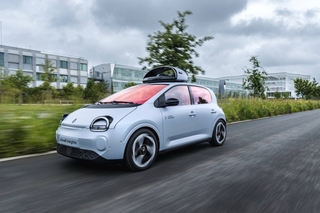
A few months ago, the 4L Vision Rescue caused quite a stir on the sidelines of the commercial launch of the R4 E-Tech. Developed in collaboration with the fire service, it served as a technological showcase for Renault, acting as an advanced rescue post to improve the efficiency of emergency response, featuring artificial intelligence and reconnaissance drones. Today, Renault is unveiling the electric Twingo “cleveR insights”, designed for local authorities. This is a city car dedicated to the collection and analysis of urban data, developed with Software République (Atos, Thales, Dassault Systems, STMicroelectronics), a European collaborative ecosystem for safe and sustainable mobility.

Mobile laboratory
Much like the ‘Google Cars’ that map our roads, the Twingo cleveR works in a similar way. Designed as a mobile laboratory, it must be able to identify road surface damage, measure noise and pollution levels, and assess certain environmental indicators such as drought levels. The aim is to provide information to local authorities (town halls, communities of municipalities, metropolitan areas, etc.) and enable them to make faster and more accurate decisions regarding infrastructure management, whilst optimising the service provided to the public.

Special interior
Sensors, cameras and equipment utilising artificial intelligence, augmented vision, predictive analytics and environmental simulation are fitted to the roof and in the boot of this electric Twingo. For example, the vehicle will be able to recognise an unusual pile of rubbish at the side of the road and deduce that it is fly-tipping, and then alert the waste collection services more quickly.
Apart from a row of tech modules mounted on the roof, there is nothing to distinguish this white ‘cleveR insights’ Twingo. The interior is more distinctive: the dashboard and trim are unique, featuring silver accents and a few touches of blue to give the whole a modern feel. This concept is not currently intended for mass production; it is a full-scale demonstrator.

Military: Renault Rafale and Trafic 4 TROOP
Among Renault’s other diversification initiatives, its defence division could see further growth depending on the current geopolitical climate. At the Eurosatory exhibition, dedicated to defence and security, Renault unveiled a project aimed at the armed forces. Specifically, two vehicles from the current range, modified and equipped with cutting-edge technology supplied by Thales (drones, sensors, AI-enhanced tools). The Rafale SUV in a hybrid four-wheel-drive version and the Trafic 4 TROOP utility vehicle, both repainted in ‘matt brown’ camouflage and fitted with all-terrain tyres. The Rafale is presented as a multi-role vehicle tailored to the needs of ground forces. Its headlights are protected by a grille, whilst the Trafic’s cargo area houses reconnaissance drones. Roof racks carry military equipment, transforming them into mobile intervention and surveillance platforms.

Tactical vehicles
These two tactical vehicles are part of the 4 TROOP programme and are designed to assist with decision-making, coordinate operations on the ground, provide logistical support and monitor sensitive areas. Electrifying the Rafale would enable other equipment in the field to be powered via its Vehicle-to-Load (V2L) system. Renault is drawing on its operational platforms and industrial capacity to offer agile solutions that can be deployed rapidly.
With these three concepts, Renault is demonstrating that its expertise extends far beyond the consumer market. From smart mobility to technological solutions for the military, the French manufacturer is exploring new avenues that combine connectivity, data analytics and artificial intelligence.

Diversification: a long-term trend
Given the many technologies being developed alongside the electrification of vehicles, it is therefore no surprise to see Renault seeking to diversify. In the military sector, in Germany, Volkswagen could convert certain underused factories into defence manufacturing sites; the same applies to Mercedes, which has been approached by a German defence contractor to produce specialist vehicles. More broadly, the development of AI, battery, sensor and software technologies will generate revenue outside the automotive sector. With sales declining and the growing presence of Chinese brands in the EV market, there is no doubt that the strategies of traditional manufacturers will evolve significantly in the coming years.