
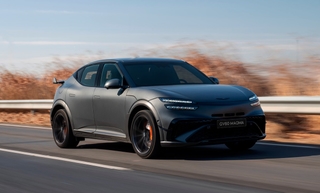



Having recently established itself in France, Genesis, the luxury brand of the Korean Hyundai-Kia Group, has just added a powerful electric sports SUV to its range: the GV60 Magma. It joins the three electric models already in the catalogue for the market launch. Like Lexus (a subsidiary of Toyota), Genesis hopes to compete with premium brands such as Audi, BMW and Tesla. Its involvement in the World Endurance Championship and the 24 Hours of Le Mans supports this ambitious manufacturer’s strategy to expand its market share.

GV60 Magma: 650 hp
It is no coincidence that Genesis is launching a high-performance SUV to coincide with its arrival in France. The premium brand of the Korean Hyundai-Kia group aims to compete with leading premium manufacturers such as BMW, Mercedes and Audi. It is therefore essential to offer a car with character, dynamism and superior performance. The GV60 Magma (Magma being the manufacturer’s sports division) is therefore a 4.52-metre electric SUV based on the same platform as the Hyundai Ioniq 5 N. With two electric motors, an 84 kWh battery and 650 hp delivering 790 Nm of torque, these specifications place it firmly in the category of high-performance SUVs. Performance is impressive: 0 to 100 km/h in 3.4 seconds and a top speed of 264 km/h. It is priced from €86,600, which is €8,000 more than its technical cousin, the Ioniq 5 N.

Standing out from premium brands
Just as Lexus is to Toyota, Genesis aims to embody the Hyundai-Kia Group’s distinctive premium offering. The Korean strategy focuses on building a long-term brand image, unlike Chinese brands such as Denza (BYD) or Xpeng, which are seeking to expand their network and sell large volumes quickly. Genesis, for example, will initially have just two sales outlets (in Lille and Paris) and will have around 50 service centres by 2028, located near Hyundai dealerships.
Furthermore, Genesis is entering the European market with a range consisting mainly of electric cars, whereas the US market offers around ten petrol and hybrid models. Faced with strict European regulations and customs duties, and whilst Genesis aims to project a technological brand image, the range therefore comprises three fully electric vehicles: two SUVs, the GV60 and GV70, and a large, prestigious G80 saloon.

A risky strategy
This decision is not without risk. Genesis remains largely unknown to the European public (building a brand image takes time), and there are now many specialist premium car manufacturers – particularly German ones – making the market highly competitive. Nevertheless, the Korean brand has no intention of selling its cars at a loss but is banking on the original design of its models, their level of equipment and superior technology, even though many components are already shared with Hyundai models. For example, the sporty GV60 Magma SUV features the e-ASD (electronic active sound design) system, which reproduces engine sound vibrations similar to those in the Ioniq 5 N. A premium approach that does not simply copy German benchmarks.

Investment in competition
Furthermore, Genesis is investing in motor racing to boost its popularity and brand image. It’s a strategy that appears to be off to a good start, given the results achieved in the World Endurance Championship (WEC) and at the 24 Hours of Le Mans with the Genesis Magma Racing team, where the two hypercars (GMR 001) entered since the start of the season are competing with the top teams. This approach is reminiscent of Audi’s successful foray into endurance racing in the 2000s. As well as the obvious boost to brand awareness, performing well in endurance races lends credibility to a technology and secures a certain prestige in the eyes of the public.

The customer experience: Genesis’s secret weapon
Finally, the Korean brand hopes to win over customers with one key selling point: the ‘Son-nim’ concept, which literally means ‘esteemed guest’. Put simply, Genesis treats its customers as guests, welcoming them with respect and care. A personal assistant accompanies the prospective buyer before and throughout their journey; pricing is designed to be transparent (with little scope for negotiation); the showrooms resemble salons; and personalised test drives are organised with an emphasis on sensory experiences, at the customer’s own pace. This approach to business stems from the Korean culture of welcome and hospitality. These are touches that the French public may appreciate. Experience and service often take precedence in the luxury car sector. It remains to be seen whether this strategy will be enough to prevent the brand from remaining merely a niche player and to position itself as a genuine alternative to premium manufacturers.