



In many parts of the world, there is still room for improvement when it comes to travelling by electric vehicle on the motorway. In the United Arab Emirates, a new infrastructure aims to tackle this problem head-on. On 12 January 2026, the country inaugurated one of the world’s largest ultra-fast charging hubs for electric vehicles, located on the strategic road linking Abu Dhabi to Dubai.

An extraordinary hub, designed for the motorway
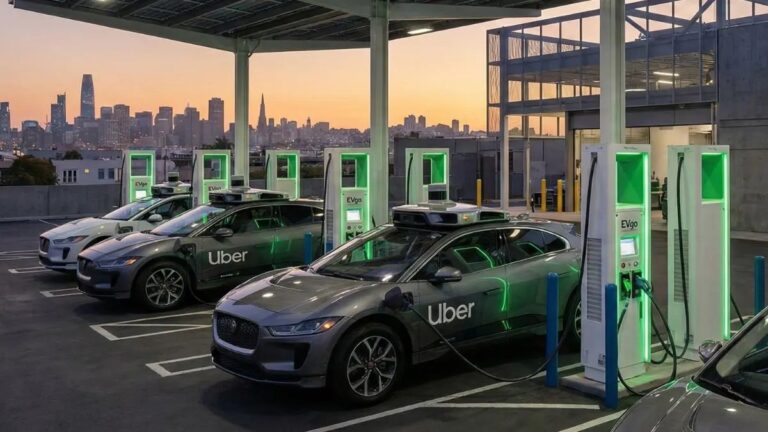
In practical terms, this new site, operated by ADNOC Distribution, brings together 60 ultra-fast recharging points capable, on paper, of recharging the majority of electric vehicles from 0 to 80% in around 20 minutes.
In reality, this performance depends very much on the vehicle connected. The charging points deliver a power of up to 350 kW, a level that can currently only be fully exploited by models with an 800-volt electrical architecture. On the other hand, models with a 400-volt architecture can of course be recharged at these stations, but without exploiting their full power.
On a global scale, this hub ranks as the sixth largest in the world in terms of the number of ultra-fast terminals, and is the largest in the Middle East, Africa and Turkey.

With this inauguration, we can now say that the United Arab Emirates have not only set up a new recharging station on their territory, but above all have created an infrastructure designed to absorb long-distance electric traffic, without creating saturation.
A strategic location at the heart of traffic flows
Impressive performance indeed, and to make the most of this facility, the choice of location is no mean feat. The hub is located in Saih Shuaib, along the E11 motorway, one of the busiest roads in the country. This road links the Emirates’ two main cities and is the hub of a large proportion of intercity travel, whether for business or pleasure.
Until now, travelling electrically on this type of journey has been possible, but less seamless. With this installation, long-distance travel becomes an accepted practice, and no longer a penalising compromise.
A symbolic inauguration at a key moment
As with the chosen location, the date of the official opening is no coincidence. In fact, the inauguration took place on 12 January 2026, just as Abu Dhabi Sustainability Week, an international event dedicated to energy transitions, opened its doors.
The timing is highly symbolic, allowing the United Arab Emirates to illustrate, through a concrete project, the messages conveyed during this global event. More than just the commissioning of infrastructure, this inauguration is part of a technological showcase strategy designed to position this hub as a benchmark for interurban electric mobility.
When an oil giant becomes a player in the electric sector
This is undoubtedly one of the most interesting aspects of this project.
The hub is being developed by ADNOC Distribution, a subsidiary of the UAE’s national oil group. It’s a powerful symbol: the traditional fossil fuel players are now investing massively in electromobility.
This site is part of ADNOC’s E2GO network, which already has more than 400 charging points in the country, with a stated target of 750 by 2028. In the longer term, the country is aiming for 20 hubs of this type on its motorway network by 2027, the majority of which will be operational by the end of 2026.

Recharging becomes an experience, not a constraint
Beyond the figures, this hub adopts a broader concept dubbed « The Hub by ADNOC ». On site, drivers will find not only kiosks, but also :
- catering facilities,
- commercial services,
- and even work areas, designed to optimise recharge time.
According to the company, the idea is simple: to turn a stop to recharge into a useful break, rather than wasted time.

What this says about global electromobility
This inauguration goes far beyond the United Arab Emirates. It illustrates several key trends in global electromobility:
- Electric vehicles are finally moving out of the urban environment. Infrastructures are beginning to be designed for the long term, which is a prerequisite for mass adoption.
- The major networks are being structured on a very large scale. 60 ultra-fast terminals on a single site is a direct response to the saturation problems still being experienced in Europe and North America.
- The historical players are changing roles. Seeing an oil group in charge of one of the world’s biggest EV hubs shows just how strategic the transition has become, including for the energy giants.
A clear vision
With this mega-hub, the United Arab Emirates are not just adding charging points to the network. They are proposing a very concrete approach to long-distance electric mobility, based on fast recharging, continuity on major routes and anticipation of future uses.
This approach contrasts with the still fragmented infrastructure seen in many parts of the world, where the issue of recharging on motorways remains one of the main obstacles to the mass adoption of electric vehicles.