



For three days, the Mercedes EQV 300 shared our daily lives: city, ring road, motorway and secondary roads. A test in real conditions, made in ECOMOTORSNEWS, to measure the value today of a premium electric van designed for families and practical uses.
A van with presence
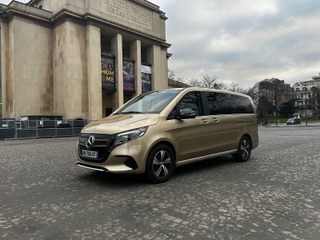
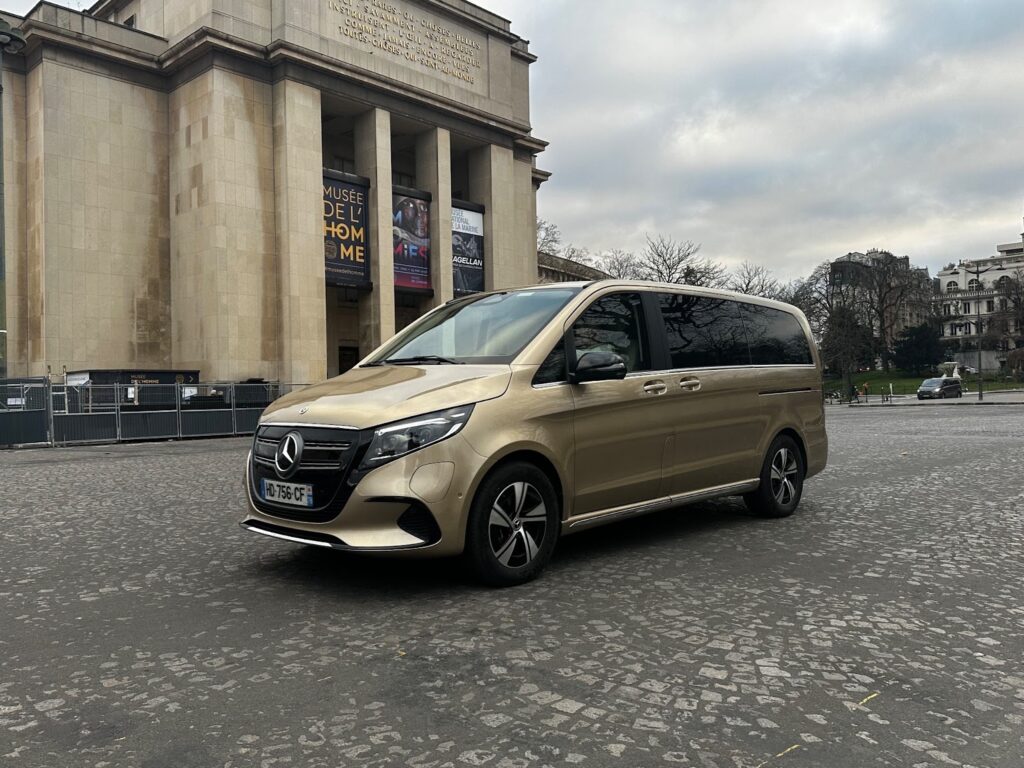
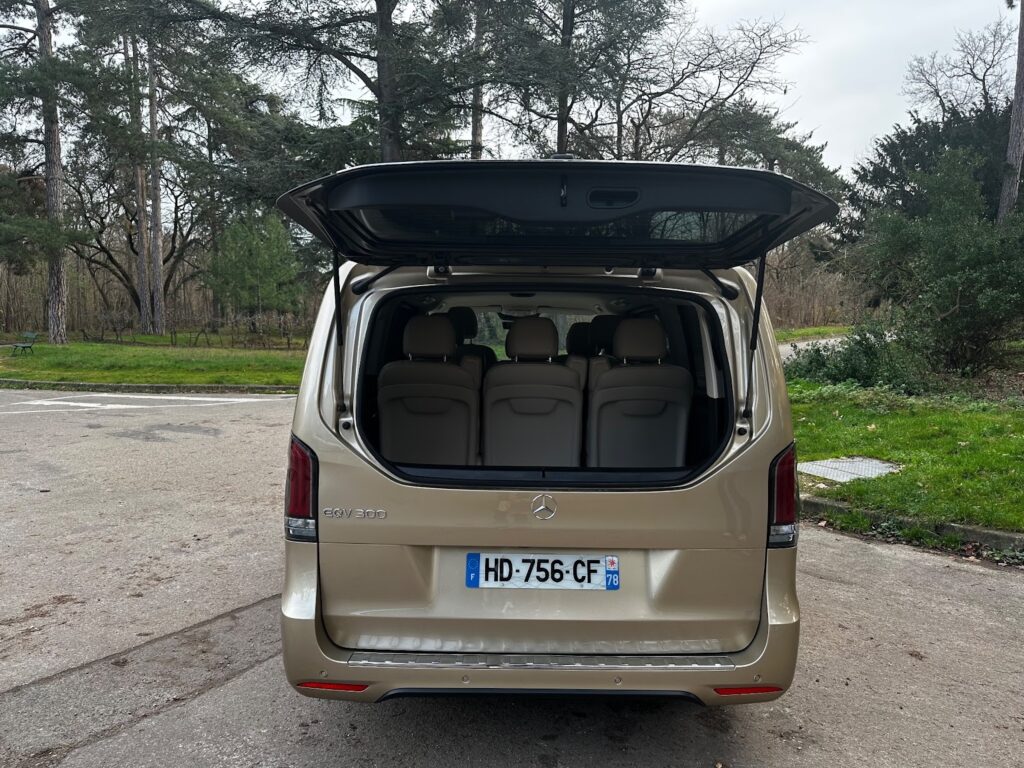
At first glance, it’s hard not to be surprised by its distinctive colour and balanced aesthetic. On the one hand, the Kalahari Gold metallic gives it a premium, distinctive and attractive look, without going over the top. On the other, the front of the vehicle has nothing to envy from a Mercedes saloon, thanks to the large grille and the big logo that command respect.
At 5.14 metres long, almost 1.93 metres wide and around 1.90 metres high, the Mercedes EQV has an imposing, assertive stature that clearly sets the tone: this is a real van, designed for space and use.
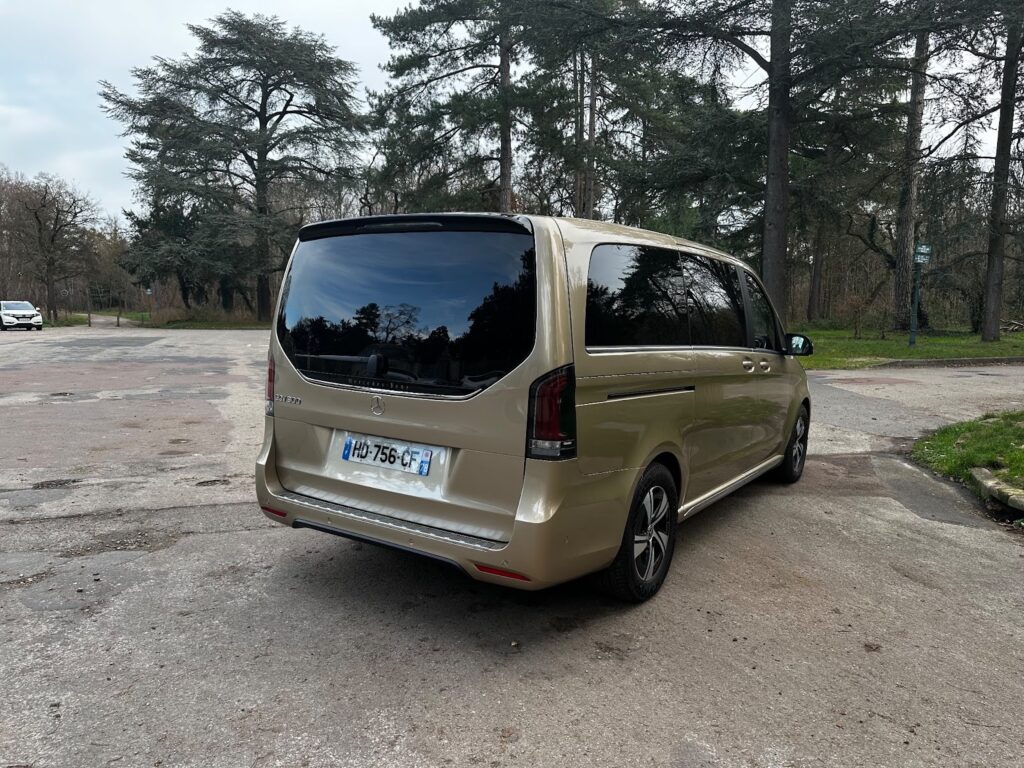
However, I was less won over by the rear end, which is too upright for my taste and lacks the dynamism to counterbalance its size. But that remains a matter of taste: for many, this format will remain the symbol of what a van should be: presence, space and efficiency.
Inside: a promise of comfort that really delivers
Opening the doors of the EQV is like discovering a well-designed room. The interior space is bright, generous and perfectly adaptable. Our 8-seater version with individual seats gives an immediate impression of versatility. Everyone benefits from a real seat and convincing legroom, even on long journeys. Unlike traditional 6-, 7- or 8-seater vehicles, the German brand’s intention with its van is clear: no ‘extra’ seats. The seats offer comfort and support worthy of a well-designed lounge chair, which is rare in this segment.
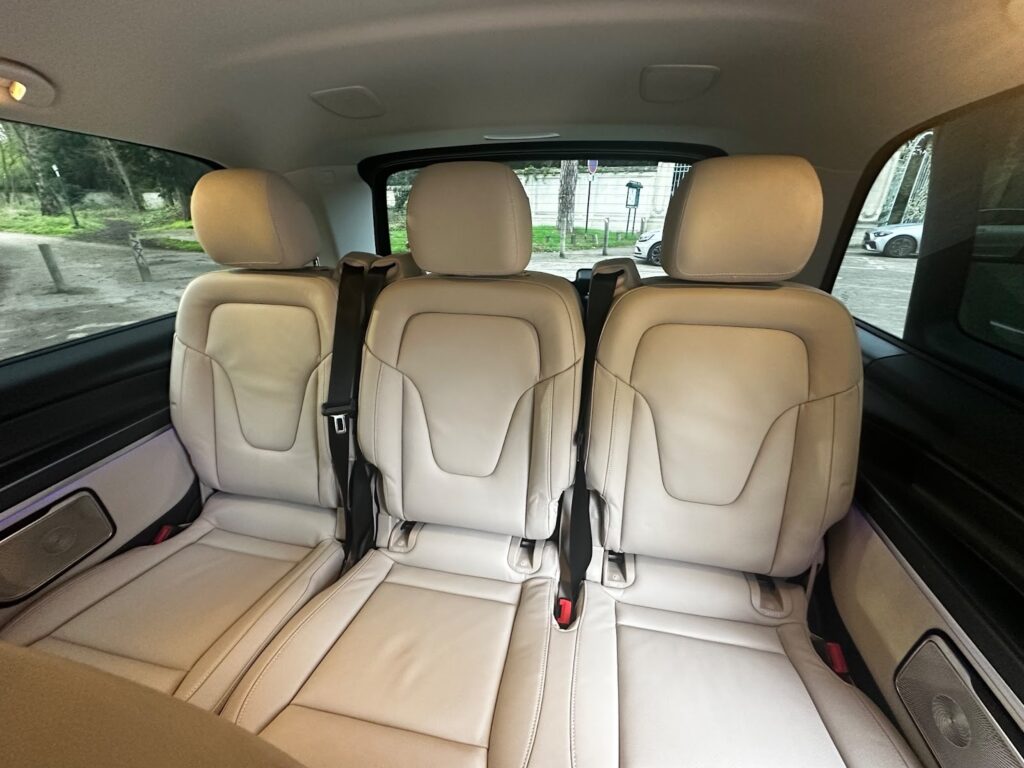
And access is pleasant too. With its large sliding doors for access to the rear seats of the vehicle, the installation is practical. In this type of vehicle with lots of seats, getting into the back seats is often an obstacle course. Here, with the EQV, everything is easy: the seats fold out and in with ease.
The Avantgarde finish we tested continues this logic. The beige leather seats, the effective digital display panel, which adds that ever-pleasing ‘high-tech’ touch, and the simple, yet not excessive, ergonomics (quite a few buttons, but well placed and without any real overload) give the cabin a premium feel, almost cocooning without being flashy.
As for the boot, with 610 litres in 8-seater configuration, it’s obviously not insane at first glance. But as soon as the seats are removed (with ease, no less), the capacity explodes. In fact, the manufacturer claims a total capacity of up to 5,000 litres, enough to carry volumes worthy of conventional vans. Another detail that really appealed to me, and that you don’t often see, is the double opening of the boot: either wide open like a traditional tailgate, or just the glass section, which can also be opened to grab a bag or pull out the charging cables quickly and effortlessly.
In town, on the road, on the motorway: smooth, adapted driving
We suspected it, but it’s confirmed: the EQV isn’t designed to flex its muscles. Under the bonnet, the electric motor develops 204 bhp and 362 Nm of torque, a power that allows this beautiful baby to adopt a fluid driving style. And unlike most EVs, acceleration is linear rather than explosive. For the intended use of this type of electric vehicle, it’s a perfect match.
City driving is pleasant and fluid, even if the dimensions require a little delicacy in narrow streets or on Parisian quays. On the other hand, on the road and motorway, the power is appropriate and, by changing modes (4 different modes in all), overtaking is still largely accessible. What’s more, its weight can become an asset: there’s no jiggle, just a quiet suppleness and an appreciable silence, especially when compared with internal combustion versions.
Let’s talk about the weight! Empty, it weighs in at just under 2.8 tonnes. The EQV 300 imposes a serious size on the road, but remains within the limits of a conventional B licence, while offering the capacity needed for long, well-laden journeys. You feel the weight when you change direction abruptly, but the handling is more reassuring than you might imagine, thanks in particular to the centre of gravity lowered by the battery. The turning radius isn’t exactly ideal, but given the dimensions, it’s understandable and not disturbing depending on use. Once again, we’re talking about a real van, not a small city car.
On-board technology: sufficient and well thought-out
Inside, Mercedes has opted for consistency rather than overkill. Facing the driver, there is a large digital panel made up of two 10.25-inch screens, united under a single panel. One is dedicated to the instrumentation, the other to the multimedia system. It’s an easy-to-read unit, well integrated into the dashboard, which adds a real high-tech touch without visually weighing down the cabin.
The MBUX system is of course part of the package. The central screen is touch-sensitive, but above all it can be controlled via a pad located on the centre console, a solution that I find particularly relevant in a vehicle of this size. This pad allows you to navigate through the menus without taking your eyes off the road for too long, where some giant screens can be more distracting than ergonomic.
It’s a far cry from the XXL screens found on some recent electric SUVs, but the interface is fluid, logical and intuitive. Essential information is quickly accessible, navigation is clear and the controls fall naturally to hand. The whole system is designed to accompany the driver, rather than dominate him or her, which is a real strength when driving in dense urban environments or on long motorway journeys.
Range and recharging: figures in line with actual use
For the EQV, Mercedes has announced a WLTP range of around 350 to 360 km for this 300 model, depending on conditions and load, which is a solid base for a vehicle of this size.
In the real world of mixed roads from Paris to the countryside, via the ring road and the main roads, I found that range varied logically according to speed and whether or not the technological equipment was activated.
What’s more, in terms of aerodynamics, the van has a drag coefficient of around 0.32, a figure that is consistent for this type of vehicle, but logically penalises it at high speeds. This translates into higher fuel consumption on the motorway, a factor to be taken into account when planning long journeys.
When it comes to recharging, the EQV can handle 11 kW AC for a full charge in less than 10 hours, and up to 110 kW DC, enabling it to go from 10% to 80% in around 40 minutes. These figures are not spectacular compared with some large electric SUVs, but they are still effective and sufficient for an electric van whose vocation is not excessive performance, but pragmatic use.
Verdict: the EQV is not a revolution, but a real answer
The EQV 300 Avantgarde does not seek to revolutionise the codes of electromobility. On the contrary, it consistently embodies what we expect from a large premium electric van: comfort, modularity, space, quality and a range adapted to real needs.
It’s perfect for large families, regular travellers looking for uncompromising comfort, or professionals who want to combine space and image without giving up the smoothness of electric power. This is not a vehicle for pleasure, but a reliable, well thought-out tool for comfort.
Whether you’re going on a road-trip with the family or a weekend loaded down with luggage and passengers, the EQV has what it takes to make it enjoyable. And on the road, its silence, comfort and flexibility are a reminder that electric power is a real choice.