
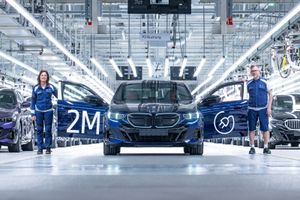

BMW has reached a milestone that is symbolic, but above all significant in industrial terms. The German group has announced that it has produced its two-millionth fully electric vehicle at its Dingolfing plant in Germany. Behind this figure lies a significance that goes far beyond mere publicity: it says a great deal about the manufacturer’s gradual shift towards electric vehicles, without abandoning its multi-energy strategy.

A symbolic milestone, and above all an industrial one
According to a press release from the BMW Group, the lucky winner is a Tansanite Blue BMW i5 M60 xDrive, assembled at the Dingolfing plant and destined for a Spanish customer. The figure speaks for itself and is highly symbolic: with 2 million electric vehicles produced, BMW confirms that it is a major player in the energy transition within the transport sector.
Although the group remains far behind the sales volumes of the global leaders – led by BYD, Tesla and the Volkswagen Group – the pace is clearly picking up. This milestone illustrates a steady rise in momentum, driven by the expansion of the product range and the gradual transformation of the German group’s factories.

An old strategy, but one that has long been progressive
Unlike other manufacturers, BMW did not wait for the recent trend to take off. In fact, the group has been mass-producing fully electric cars since 2013 with the BMW i3, which is assembled in Leipzig.
This pioneering model laid the foundations for the “i” range, but its popularity grew only gradually over several years, as the brand’s hallmark has always been its high-performance combustion engines.
It is particularly since the early 2020s that the manufacturer has stepped up a gear, with a proliferation of models and a more far-reaching transformation of its manufacturing facilities.

Dingolfing, BMW’s industrial heartland for electric vehicles
The press release issued on 5 May 2026 highlights Dingolfing, and this is no coincidence. The Lower Bavarian site is now BMW’s main industrial showcase for electric vehicles. Since 2021, it has been producing models such as the BMW iX, the BMW i7 and the BMW i5, all of which are electric.
In four years, more than 320,000 electric vehicles were assembled there, accounting for nearly one-sixth of the total. More recently, in 2025, more than a quarter of the site’s production was already 100% electric.
Above all, Dingolfing is not just an assembly plant. The site has produced over 1.5 million electric motors and more than a million high-voltage batteries. In other words, it is a key hub in the group’s electric vehicle value chain.

An industrial network that is already largely electrified
But whilst the Dingolfing plant is being highlighted, it is in fact just one key part of a wider network. BMW now produces electric vehicles at all its major German plants, including those in Munich, Regensburg and Leipzig.
Internationally, production also relies on sites such as Shenyang in China and Spartanburg in the United States, depending on the model and components.
This structure enables the group to scale up its operations without relying on a single site, whilst preparing the next generation of “Neue Klasse” vehicles.
A conscious choice for multi-energy
This is the other key message in the press release. BMW is not opting for an abrupt switch to all-electric vehicles. The manufacturer continues to produce petrol, hybrid and electric models on the same assembly line.

This ‘mixed production’ approach allows production to be tailored to demand on a market-by-market basis. It is a more flexible approach than that of some competitors, who completely separate their production lines, thereby running the risk of overproducing in the face of demand that can fluctuate depending on various factors. In other words, BMW is safeguarding its transition by keeping all options open.
Electrification that will continue to gather pace
The German giant’s strategy is well known: it aims for around 50% of its sales in Europe to be electric by 2030. And some sites will make the switch more quickly than the rest of the group; a prime example is the Munich plant, which is set to become 100% electric from 2027.

Reaching the 2 million vehicle milestone confirms a fundamental trend: at BMW, electric vehicles are no longer a separate segment, but a core part of the business.