


On Saturday 13 December 2025, Valérie Pécresse and various elected representatives inaugurated Câble C1, the largest urban cable car in the Paris region. At 4.5 km long, this 100% electric project will halve journey times between Créteil and Villeneuve-Saint-Georges. A suspended revolution that redefines sustainable mobility in over-burdened urban environments.
A grand opening in Limeil-Brévannes
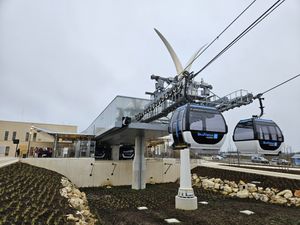
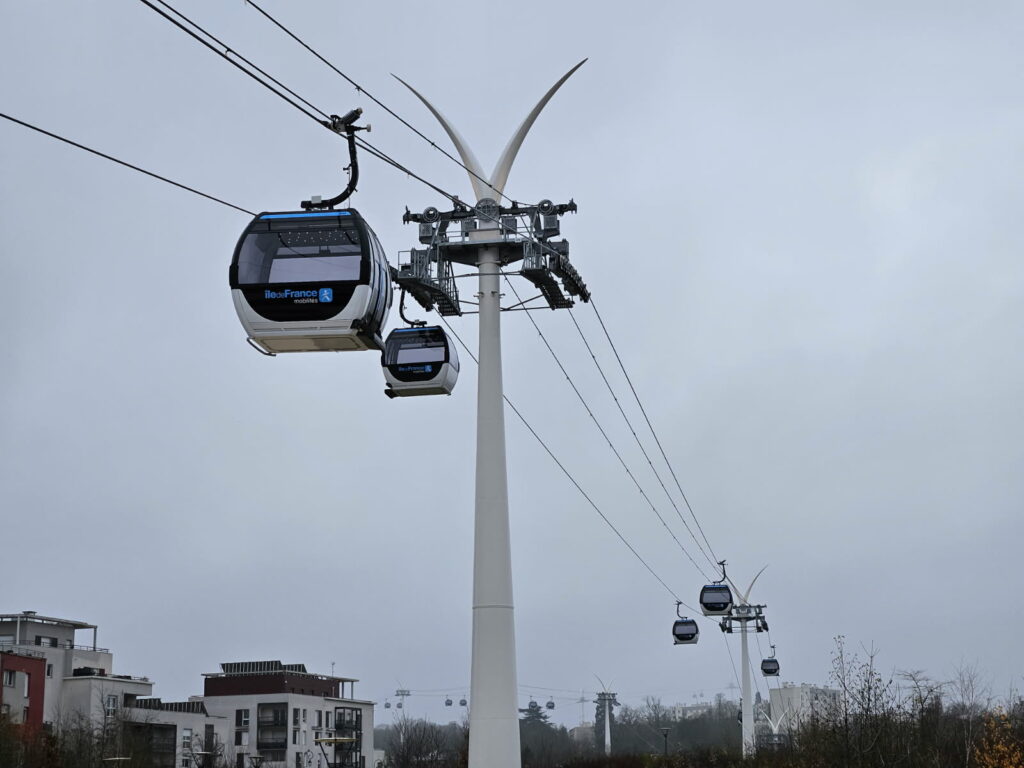
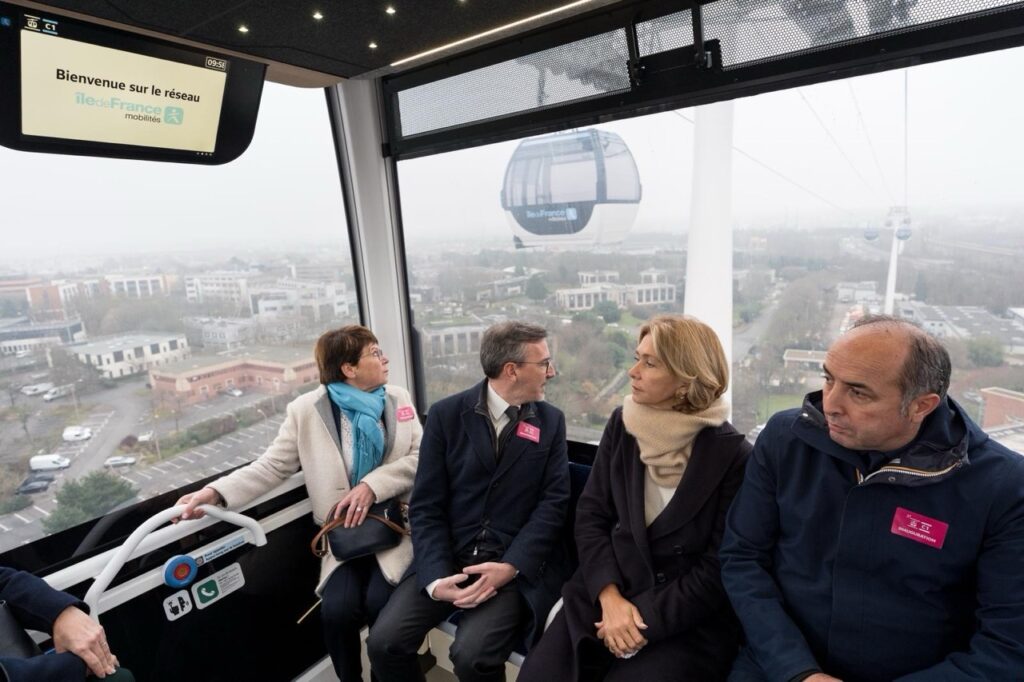
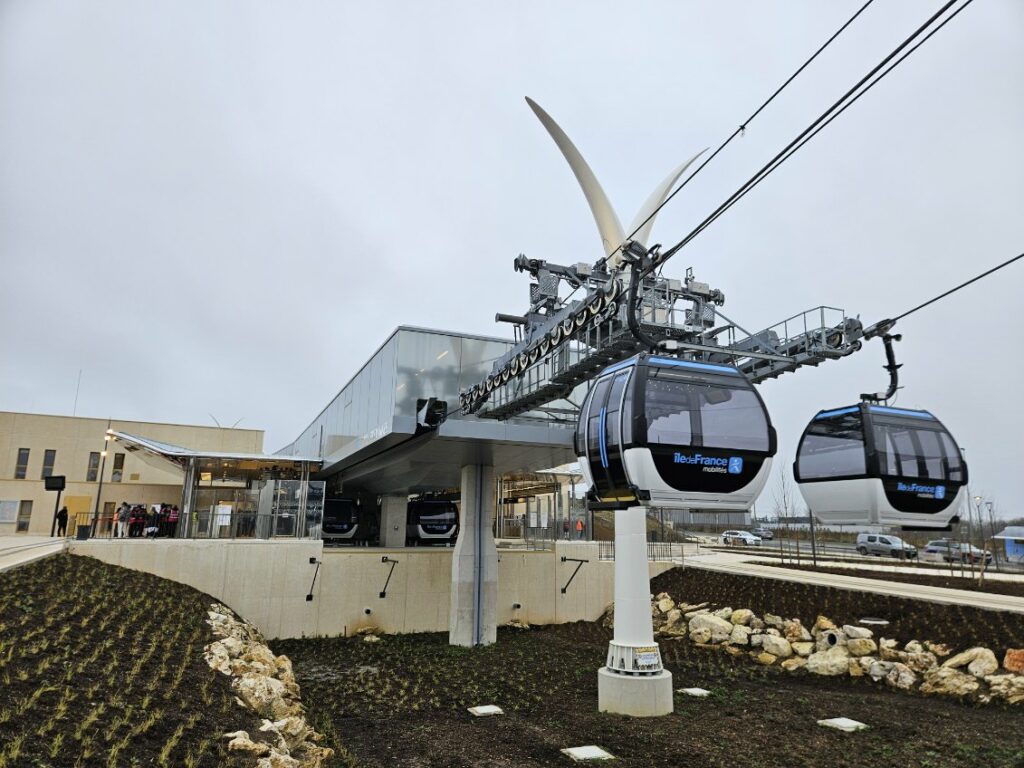
The inauguration ceremony was held in Limeil-Brévannes on Saturday morning. Families, elected representatives and curious onlookers flocked to the five Cable C1 stations to be among the first to board these cabins suspended at heights of over 40 metres above several Val-de-Marne communes. In all, no fewer than ten people can travel in a single cabin, seated and enjoying a panoramic view of the area.
The morning was attended by many of the elected representatives and decision-makers involved in this project, which was launched 12 years ago in 2013. Valérie Pécresse, President of the Île-de-France Region and of Île-de-France Mobilités, was present alongside Marie Gautier-Melleray, Prefect and General Secretary for Public Policy, Étienne Stoskopf, Prefect of Val-de-Marne, Olivier Capitanio, President of the Val-de-Marne Department, Louis Boyard, Member of Parliament for Val-de-Marne, and the mayors of the municipalities through which the project passes: Françoise Lecoufle (Limeil-Brévannes), Kristell Niasme (Villeneuve-Saint-Georges), Métin Yavuz (Valenton) and Édouard Hénault, representing Créteil. Jessica Larsson, Head of the European Commission Representation in France, was also present to symbolise the European co-financing of the project.
« It’s the Alpes sur Marne! » said Valérie Pécresse. « We’re coming to the end of an obstacle course that’s lasted more than 10 years. We had to find the funding, convince the local residents… For the people of Val-de-Marne, this is a sign of consideration. »
18 minutes against 40
So why decide to create an urban cable car? Well, the initial data is demonstrative: before C1, the journey from Villeneuve-Saint-Georges to Pointe du Lac station, the terminus of the metro 8, took over 40 minutes by bus or car, stuck in traffic jams on the RD 101 and the RN 6. The cable car, on the other hand, makes the journey in 18 minutes, over obstacles such as the TGV high-speed train line, the Valenton marshalling yard, the RN 406 and high-voltage power lines.
What’s more, the service operates from 5.30am to 11.30pm on weekdays, and until 12.30am at weekends. A cabin runs every 30 seconds during rush hour, which means that 11,000 passengers are expected to use the service every day. To take advantage of this new urban improvement, you need to have a Passe Navigo or, for occasional travellers, buy a Bus-Tram-Câble ticket worth €2 (€1.64 with Liberté+). Access is free for children under the age of 4.
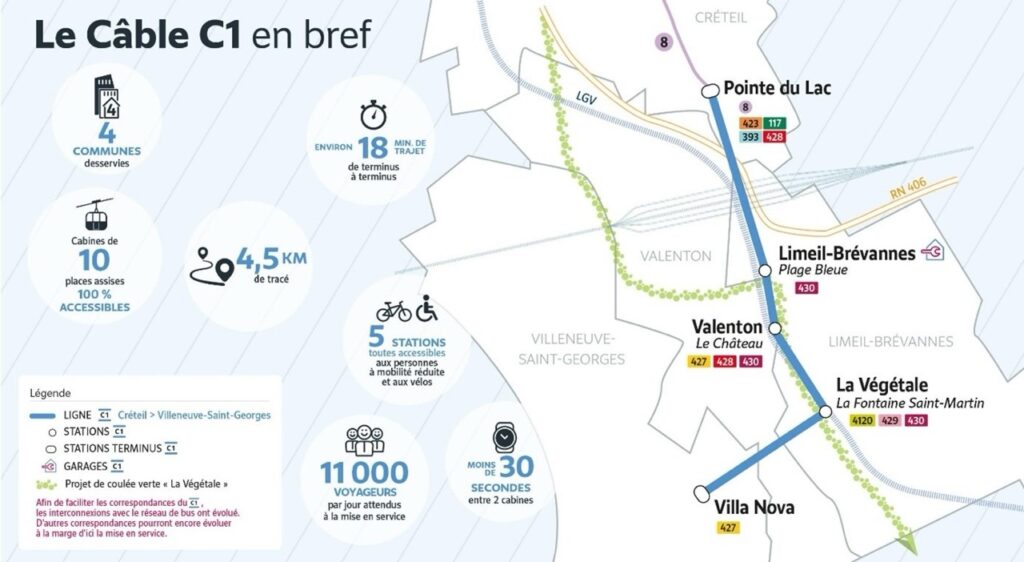
While the C1 Cable is a fast, environmentally-friendly alternative to the car, its limited capacity of just over 10,000 passengers per day shows that it is still a complementary solution to other modes of transport. Intermodality with the metro and bus remains essential to meet all mobility needs on the route.
An ecological project
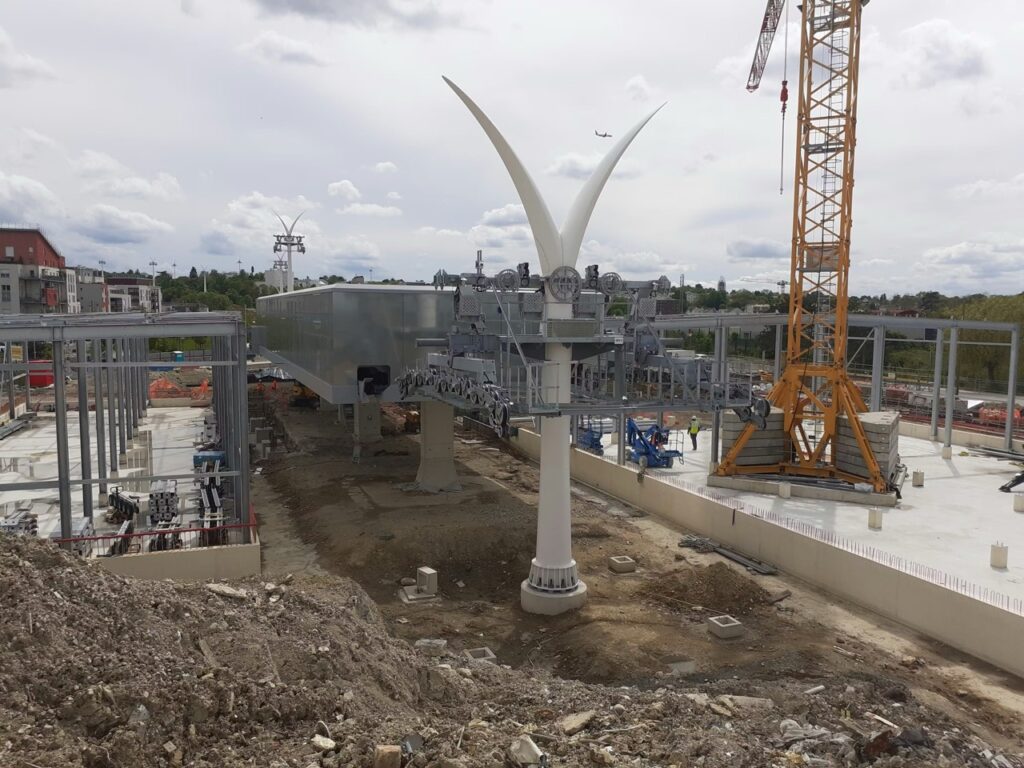
The C1 Cable is 100% electrically powered and has been awarded HQE Sustainable Infrastructure certification. Its 30 pylons have a reduced footprint, preserving the green spaces they cross, in particular the Tégéval green corridor.
This monocable carrier-tractor technology is less invasive than a metro or tramway, since it avoids the construction of heavy engineering structures and reduces the duration and intensity of the work, and therefore the pollution and emissions associated with conventional worksites.
By offering a fast, regular alternative to the car on a route that is currently saturated, the C1 should help to reduce traffic jams and, in turn, CO₂, NOx and particulate emissions linked to daily road traffic in the area.
C1 has a total cost of 138 million euros (132 million for the infrastructure, 6 million for the 105 cabins). « An underground metro would never have seen the light of day because the budget of over a billion euros could never have been financed, » explains Grégoire de Lasteyrie, vice-president of the regional council in charge of transport. Just three years of construction work, from the ground-breaking ceremony in 2022 to the inauguration on Saturday, have also made it possible to limit the impact of a major transport project on the quality of life of local residents.
Financing: a tripartite arrangement
One of the sinews of war when it comes to financing this kind of project is often finding the funds needed to make it a success. And the €132 million needed to build the infrastructure is 49% funded by the Île-de-France Region, 30% by the Val-de-Marne Department, and 21% by the State and the European Union. The cabins (6 million euros) and operations are financed 100% by Île-de-France Mobilités.
The 21% EU funding underlines Brussels’ commitment to innovative electric mobility in dense urban areas. And the Câble C1 is the perfect embodiment of this European priority: a 100% electric, HQE-certified mode designed to replace car journeys on congested roads and reduce emissions. The presence of representatives from the European Commission at the inauguration, including Jessica Larsson as Head of the Representation in France, illustrates this desire for visibility: Europe is concretely financing low-carbon alternatives that are suited to constrained areas like Val-de-Marne.
There are several reasons for the EU’s support:
- Decarbonisation objective: C1 pools energy on cables for lightweight cabins, optimising consumption per passenger-km compared with the predominant combustion-powered cars on the RD 101/RN 6.
- European scale: this funding is part of the Green Deal and the sustainable mobility funds (CEF Transport, Connecting Europe Facility), which prioritise low-carbon air projects in urban areas.
- Replicable model: with a total cost of €138m (compared with €250m/km for the metro), the C1 is becoming a textbook example for other European cities.
Safety and acceptability
Cable cars are considered to be one of the safest means of transport in the world, according to the Ministry of Transport’s technical department. In France, the last fatal accident occurred in 1999 in the Hautes-Alpes region.
For this new investment in environmentally-friendly transport, each cabin is equipped with video surveillance, an intercom linked to the control centre at Limeil-Brévannes, and staff on hand at the station. The system works in snow and winds of up to 70 km/h. Sensors continuously monitor weather conditions.
And if Parisian transport, like the metro for example, is poorly equipped with access for people with disabilities, leaving out people who cannot move around freely, with the Câble C1, this problem has been solved. The cable car is 100% accessible for people with disabilities:
- level stations
- wheelchair-friendly cabins
- human assistance at the station
- audio and visual information
- call intercoms
- guide strips from the public space to the boarding platform
A laboratory for the future of mobility
C1 proves that it is possible to open up the region effectively without sinking a billion euros into an underground metro. But capacity remains limited (11,000 passengers/day compared with 500,000 for a conventional metro line), and the technology is not suitable everywhere. It excels in constrained areas, where there is a strong need for intermodality and where there are major height differences or obstacles.
More than just a technological gimmick, this urban cable car embodies a pragmatic vision of decarbonising transport: providing a fast, reliable, electric alternative to combustion-powered cars in congested areas. With the C1, electric mobility now comes from above.