

The launch of a new Ferrari is always a major event. The fact that it is electric makes it all the more sensational. But did fans and purists anticipate such a radical departure, both in terms of style and
technology, with the Luce (‘Light’ in Italian)? An imposing model that is aesthetically difficult to describe, remarkable in its interior design, technically in line with
current electric sports cars, and excessively expensive. Introducing a car that redefines electric luxury and must establish its own standards in the face of new rivals from Asia.

Luce: an Apple spin-off for the automotive industry?
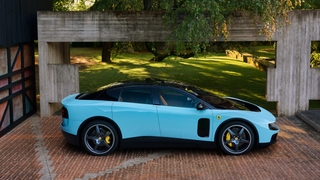
Unveiled in Rome, the Ferrari Luce could be likened to an Apple-inspired automotive product, such is the influence of the design conceived by Marc Newsom and Sir Jony Ive—the designer behind the iPhone and Apple Watch—which is evident in its presentation. Aesthetically, this monolithic, streamlined shape may come as a shock to those accustomed to the taut lines, generous curves and elegant forms of entire generations of Ferraris. These design choices were primarily dictated by the need for aerodynamic efficiency. Like the
windscreen wipers positioned vertically on the windscreen, it is inelegant but necessary. Airflow is thus channelled from the nose to the roof and via black lacquered side vents around the wheels. The very clean lines symbolise the technological marvel beneath this
bodywork. Measuring 5.02 m in length (5 cm longer than the Purosangue SUV), 2 m wide excluding the wing mirrors and 1.54 m high, the Luce is a sort of crossover that is part saloon, part MPV and part coupé. A few details, such as the round rear lights and the yellow logos on the sides, serve as a reminder that this is indeed a Ferrari.

More innovative and inspiring on board
The Luce is the first five-seater Ferrari in history. A unique feature is that the three rear-seat passengers enter via rear-hinged doors, which makes access much easier. Thanks to its electric powertrain, the long wheelbase (2.96 m) and the absence of a central transmission tunnel provide a level of interior space unprecedented in a Ferrari. The same goes for the XXL boot size: 597 litres, a record for a Prancing Horse model.
But it is at the front that the design is radically new for a Ferrari. The approach is intended to be very high-end neo-retro. The steering wheel has a slim rim, reminiscent of 1960s racing cars. The materials used, such as recycled anodised aluminium, Corning® Gorilla® Glass and premium leather with Alcantara-lined storage compartments, contribute to this concept of transforming the car into an object of desire. The dials are digital but retain a needle; only the backgrounds change on demand.

It’s the little things that matter
In addition to the attention to detail in the finish and the perceived quality of the materials and assembly, a few ergonomic details demonstrate that Ferrari is entering a new dimension. The ignition key, a small rectangular control, slides into the centre of the centre console and turns black when the engine is started, as if to symbolise the connection between the driver and the car. The adjustable centre console (which nevertheless retains physical controls) draws its inspiration from digital interfaces, as does the rear control panel, which displays real-time driving information to passengers.
On the overhead panel, positioned much like in an aircraft cockpit, a “Launch Control” pull-cable lever is used to activate the standing start procedure. Finally, the steering wheel features both the famous “Manettino” with five driving modes (Ice, Dry, ESC off, etc.) and the new “e-manettino” with three settings (Range, Tour, Performance: power, torque curve and drive mode) to select the most appropriate use of energy.

Average electric technology
Designed and manufactured in Maranello, the Italian brand’s home base, the NMC (nickel-manganese-cobalt) battery comprises 210 cells. It has a capacity of 122 kWh and its 800 V high-voltage architecture enables high charging power of up to 350 kW.
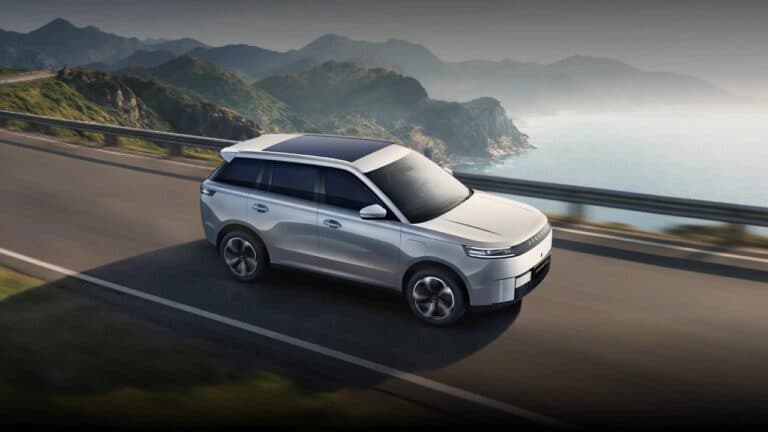
The Luce can recharge 70 kWh of energy in 20 minutes, which is about average for its class but is far outpaced by the ‘Fast Charging’ speed of the Chinese Denza Z9GT (9 minutes from 10% to 97%). There are no miracles when it comes to the claimed range, which is around 530 km and will likely be significantly lower in real-world use.
Ferrari has fitted four radial-flow motors (as opposed to the axial-flow motors on the Mercedes-AMG GT 4-door). One motor per wheel delivers 310 kW of power and 355 Nm of torque at the rear, and 105 kW/140 Nm at the front. The total power output is 772 kW, or 1,050 hp.
These electric traction motors are combined with an electronically controlled active suspension (derived from the F80 supercar) and a four-wheel steering system, all of which operate in perfect synchronisation. True to its tradition, Ferrari has developed these technologies and their components in-house: from the motors to the batteries. The project involves 60 technical patents to ensure long-term quality and exclusivity.

Performance on a par with its competitors
The Luce delivers over 1,000 hp, with a maximum torque of 990 Nm. Ferrari claims performance figures that are ultimately quite similar to those of its rivals (notably the Mercedes-AMG GT 4-door). It goes from 0 to 100 km/h in 2.5 seconds and from 0 to 200 km/h in 6.8 seconds, with a top speed of 310 km/h. What about the agility of this Italian electric car? All-wheel drive is a first for Ferrari, but it allows the potential of torque vectoring to be harnessed with precision and consistent responsiveness, whilst the torque transfer system and regenerative braking ensure smooth torque delivery and engine braking worthy of a sports car. Dynamic performance should therefore be impressive despite the high weight associated with the floor-mounted batteries (2,260 kg).

Unpublished acoustic work
In Sport mode, an artificial sound is played through the 21 speakers in the cabin. This sound is a balanced blend of the powertrain’s sound and an unprecedented level of acoustic and vibration comfort derived from metal and captured in real time. A sound that is further amplified in ‘Perfo’ mode. Ferrari has therefore chosen not to reproduce the roar of a V8 or V12 engine, but instead demonstrates its commitment to recreating an atmosphere very close to natural vibrations. Inventing a new emotional language: a Ferrari signature in the electric era.

A high price to pay for exclusivity
Ferrari never produces concept cars, and it is risky for such a prestigious brand to launch a completely new all-electric model without going through this prototype stage. This ‘pilot’ model should enable the brand to validate its choices, take into account the reactions of the fan base (which has given this launch a mixed reception) – a very significant factor at Ferrari – compare it with rival technologies, and affirm the brand’s stance on this new energy source.
Then there is the Luce’s sky-high price tag: from €550,000, excluding tax and optional extras. This is both unreasonable and baffling given that its specifications are no better than those of its competitors and even inferior to certain Chinese models. But the Prancing Horse continues to cultivate its exclusivity and its legendary status.

Can Ferrari win people over?
Neither a true supercar in terms of its looks and proportions, nor a long-distance GT, perhaps the Luce should be seen as a new-generation family saloon. But does it retain Ferrari’s DNA? It looks more like a blank cheque given to designers to create a desirable, fantasy version of electric mobility – the car seen as a status symbol seeking a new clientele more inclined towards technology.
Who is this car aimed at? By ditching the combustion engine, Ferrari is challenging the legend with the Luce, for which sales are expected to be low. Some experts estimate that around 1,000 units will be produced each year, representing less than 10% of annual production volumes.
In any case, it is Ferrari’s first response to the growing global trend towards electric mobility. Unlike other manufacturers who are taking a more wait-and-see approach (such as Lamborghini, Porsche and McLaren), the Maranello-based brand is forging ahead and setting out its vision in response to the standards imposed by China.
Even if it means treating this Luce as a full-scale trial run, the aim being to replace it fairly quickly to make way for new technical solutions, as the electric vehicle sector is evolving very rapidly.