




In Russia, electromobility is not following the same trajectory as in many European or Asian markets. In May 2026, the country has set itself significant industrial targets, but sales of electric vehicles remain modest. Behind the government’s targets, the reality of the market remains characterised by a heavy reliance on Chinese manufacturers, a constrained economic environment and a local industry still in its infancy. This contrast sums up the situation in Russia today: an ambitious public strategy, but a market still finding its stride.

An electricity market that is slowing down after several years of growth
After several years of rapid growth, the Russian electric vehicle market has seen a sharp slowdown. In 2024, 18,217 new electric vehicles were sold, according to Autostat Info. In 2025, registrations fell to around 12,500 units, a year-on-year decline of approximately 30%.
Although figures for 2026 are still scarce in public sources, a trend is already emerging: the Russian electric vehicle market remains below 2% of the total car market.
However, this decline does not signify a withdrawal from the political arena. On the contrary, Moscow continues to step up its industrial programmes relating to batteries, charging infrastructure and domestic production.

Chinese brands that have become household names
The Russian market is now largely dominated by Chinese manufacturers or by vehicles assembled locally using foreign technology.
In 2025, Zeekr retained the top spot with around 3,000 sales, despite an annual decline of nearly 61%.
Behind them, several players stand out:
- Evolute: 1,800 vehicles (+45%)
- Amberavto: 1,126 vehicles
- Avatr: 978 vehicles
- Moskvich 3: 880 vehicles
Another analysis of the market, which includes electric and plug-in hybrid models, also reveals a strong presence of other players such as LiXiang, Voyah, Tesla and others.
This Chinese dominance has become one of the defining features of the current Russian market.

The most prominent electric models on the Russian market
As for the models, a few vehicles account for the majority of registrations. The available statistics show a clear dominance of Chinese models and locally assembled vehicles.
In the first half of 2025, the Zeekr 001 dominated the market with 775 registrations, confirming its leading position in the Russian electric vehicle segment. Behind it came the Evolute i-PRO with 454 units, followed by the Moskvich 3e (350 units), the Avatr 11 (298 units) and the ORA 03 (245 units).
The market also saw changes during the second half of the year. From September–October 2025, the Amberavto A5 briefly became the country’s best-selling electric model, with 358 units sold in October alone, ahead of the Zeekr 001 (148 vehicles) and the Evolute i-JOY (99 units).
Once a major player in the Russian market, the Nissan Leaf has seen its market share decline sharply following the mass influx of Chinese manufacturers.

A national industry still striving for independence
Russia has several domestic players in the electric vehicle sector, but their level of technological independence remains mixed. A large proportion of current projects rely on foreign partnerships, mainly with China.
The leading player remains AvtoVAZ, the country’s long-established manufacturer known for its Lada brand. The company has been working for several years on a new platform designed to accommodate a range of powertrains: internal combustion, hybrid, natural gas and electric. The stated aim is a gradual ramp-up by 2027–2028, even though the group is not yet a major player in the Russian electric vehicle market.
Another major player is Evolute. The brand has become one of Russia’s leading electric vehicle manufacturers and regularly features among the country’s best-selling models. In 2025, it recorded around 1,800 registrations, representing a 45% year-on-year increase. However, its technology still relies heavily on foreign partnerships.
Another notable player is Amberavto, developed by Avtotor, a company based in Kaliningrad. The brand has gained significant visibility thanks to the Amberavto A5, which sold over 1,100 units in 2025 and has become one of the most prominent electric models on the Russian market.
Another historic name has returned to the limelight: Moskvich. The manufacturer, which was recently relaunched, markets the Moskvich 3e, an electric SUV that recorded nearly 880 registrations in 2025.
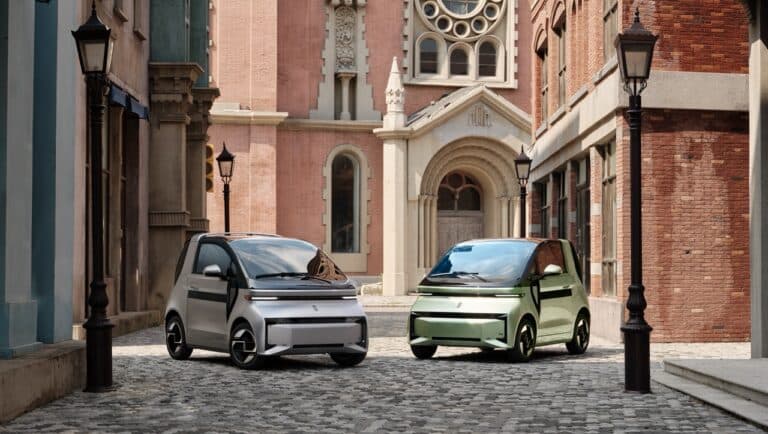
Finally, the most symbolic project remains that of Kama, with its Atom vehicle. Billed as the first electric car developed entirely in Russia, the model is set to mark a significant milestone for the local industry. For the time being, however, the Atom remains primarily a strategic industrial project rather than a genuine commercial player in the market.

A highly ambitious public policy on charging
To develop electric mobility, countries and businesses often need the support of policymakers. In this regard, the Russian government continues to set particularly ambitious targets for infrastructure.
An official plan for 2030 is in place, which includes the creation of 72,000 charging stations and 28,000 fast-charging points. Hydrogen is also part of the Eastern European country’s plans, with 1,000 hydrogen stations set to be built.
And because this sector needs people to grow, Russia plans to create 39,000 additional jobs in the battery, electronics and electrochemistry sectors
The government has also announced an additional budget of 5.7 billion roubles for 2025 to support the installation of around 1,900 DC fast-charging stations with a capacity of at least 149 kW.
By 2024, Russia already had around 2,000 fast-charging stations, a sign of real progress but still a long way from its stated targets.

Financial support to stimulate demand
Government support is not limited to infrastructure.
Among the measures highlighted:
- purchase subsidies of up to 25% of the vehicle’s price
- up to 625,000 roubles
- free use of toll roads for electric vehicles under certain schemes
- support for locally-based manufacturers
Moscow’s stated aim is clear: to ensure that one in ten cars produced in Russia is electric by 2030.
Gradually, Russia’s strategy appears to be shifting from a focus on direct purchase support towards a broader approach that encompasses industry, batteries, infrastructure and employment.
Structural constraints remain significant
Despite these ambitions, a number of obstacles continue to hamper the sector’s development.
The first relates to international sanctions linked to the conflict with Ukraine. These sanctions are making it more difficult to access components, software and certain battery-related technologies.
The second is the heavy reliance on Chinese manufacturers, who, as you have read previously, now play a central role in sales and supply.
The third obstacle is the size of the market itself. Volumes remain too low to generate economies of scale comparable to those of major global markets in the short term.
Finally, the country’s geographical characteristics also complicate the development of electric mobility: long distances and extreme winter temperatures.

Electric mobility is still largely driven by the state
By May 2026, Russia will not yet have a mass-market electric vehicle sector. However, it already has a well-defined industrial strategy. Indeed, the Russian electric vehicle sector is currently built on three pillars: local production, infrastructure and battery technology.
But for the time being, the real estate market remains heavily dependent on government decisions, financial support and Chinese partners.
The challenge in the coming years will therefore likely not be merely to increase sales, but also to transform these policy ambitions into an industrial sector capable of becoming self-sufficient.