
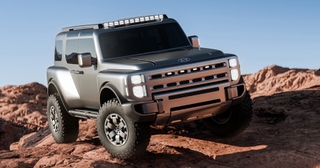

At the 2026 New York International Motor Show, Hyundai unveiled the Boulder Concept. A body-on-frame 4×4 with a bold design, it offers a glimpse of a mid-size pick-up expected around 2030. But behind the product itself, the Korean manufacturer is primarily posing a strategic question: how does a major player in electric mobility establish itself in a segment that has historically been dominated by internal combustion engines, is highly codified, and has been dominated for decades by the Americans and the Japanese?

New York, the right place for this message
Hyundai could have unveiled this concept at a motor show with a stronger focus on technology or electric vehicles. But it chose New York – the market where 4x4s are most successful, given American tastes. Indeed, it is in the US that the Jeep Wrangler, Ford Bronco and Toyota 4Runner are sold, three models that the Boulder is directly targeting, even if it doesn’t name them.

The concept builds on the Hyundai Crater, unveiled in 2025, but with an approach that this time seems more structured and closer to actual production. This high-profile unveiling feels more like a statement of intent than a formal exploration.

First, the architecture: a separate chassis – a choice with serious implications
The most important aspect of the Boulder isn’t its design. It’s its technical underpinnings. The project is based on a future body-on-frame platform. This term means that the chassis is separate, as is typical of large American 4x4s and pick-up trucks. The manufacturer has promised that this chassis is intended to form the basis of a pick-up truck around 2030.
This choice says something fundamental about Hyundai’s ambitions. Because without a separate chassis, there is no serious towing capability, no real off-road capability, and therefore no real credibility in this segment, where the car is very often a genuine workhorse.

As for the Boulder’s powertrain, Hyundai has not yet confirmed any specific engine options. The door remains open to hybrid or electrified solutions, but nothing has been finalised at this stage. What is clear, however, is that the manufacturer is keeping all options open, and that its overall electrification strategy provides a framework for this project.
A design that doesn’t try to please everyone
The Boulder adopts the brand’s “Art of Steel” design language, but takes it in a direction that is radically different from that of the Ioniq or the Tucson (the brand’s best-seller). It’s plain to see: this is clearly not a model with flowing lines, nor one that optimises aerodynamics, nor one with taut surfaces. Instead, much like what Range Rover has achieved with the Defender, we’re dealing with massive volumes, sharp angles, broad and compact proportions, and clearly visible protective elements.

For the manufacturer, this is typically a vehicle designed to be practical, and that is precisely what makes it a credible contender in this segment. The interior follows the same philosophy: reinforced materials in high-contact areas, plenty of physical controls, modular surfaces, and a layout designed with outdoor and professional use in mind. Hyundai has also incorporated a digital assistance system designed for off-road driving, an area where the brand can set itself apart from its long-standing competitors thanks to its lead in on-board electronics.

What the Boulder tells us about Hyundai’s strategy in North America
It would be simplistic to view the Boulder solely as an SUV concept. It must be seen within the broader context of the Hyundai Group’s roadmap, which aims for 5.55 million global sales by 2030, 60% of which will be electrified vehicles—including hybrid, plug-in hybrid and fully electric models. More than 18 hybrid models are announced for the period up to 2030.
North America plays a central role in this strategy. Hyundai is ramping up local production with the Metaplant in Georgia, which is set to add an additional 500,000 units, bringing the global total to an extra 1.2 million units by 2030.
In this context, the launch of the Boulder signals Hyundai’s desire to move away from its image as a manufacturer specialising in well-finished on-road SUVs, and instead establish itself in segments with a stronger cultural presence in the United States: pick-up trucks and 4x4s.

The real question raised by this concept
What the Boulder Concept reveals is the next stage in Hyundai’s American ambition: no longer content to remain in the segments where it is already a familiar presence, but instead taking on a traditional internal combustion engine market head-on with an approach that could, in time, incorporate an electric dimension.
It is an industrial and cultural gamble. The US market for 4x4s and pick-up trucks has not yet made the switch to electric, with adoption levels still limited and very specific expectations regarding towing capacity and real-world range. But Hyundai is betting that by 2030, when the production model based on the Boulder is ready, conditions will have changed. The answer will lie in the product – see you in 2030.