





Lagging behind China and the United States, where autonomous (and therefore electric) cars are already a commercial reality, Europe must develop its shared mobility offering without relying on foreign players who are already at the cutting edge of the technology. The aim is to increase the average occupancy rate of cars on the road, roll out a structured system for everyone, and maximise the social benefits that autonomous vehicles can bring. In short, prioritising mobility that benefits the community rather than individual robot-taxi services.

Europe is lagging behind; France sounds the alarm
The High Commission for Planning and Strategy is sounding the alarm over Europe’s lag in the development of autonomous vehicles. A reading of the report drafted by Thomas Matagne, CEO of the start-up Ecov, leaves no room for doubt. European Union countries have only a few dozen autonomous vehicles on the road, in certain selected cities and often as short-lived trials. In contrast, in China and the United States, the technology is already a well-established commercial reality: autonomous vehicle services are freely accessible to the public, and the companies operating them are expanding and becoming increasingly profitable (some autonomous car journeys are already cheaper than a taxi ride in China). Without an action plan, within a few years, there is a risk of becoming a ‘digital colony’. Europeans would be forced to rely solely on these foreign operators to travel safely and to have their mobility data exploited. In other words, a loss of sovereignty in the transport sector.

Autonomous driving for everyone
However, “autonomous driving is for everyone,” explains Thomas Matagne. Private cars account for 81% of the road mileage covered by the French each year. The average occupancy rate of a car, which has five seats, is just 1.6 people per car for all journeys combined and barely 1.07 for commuting. The low utilisation rate is also a weakness: on average, a car is only used 5% of the time.”
The advent of autonomous vehicles therefore presents an opportunity to rethink how we use cars as a means of transport. Indeed, the primary benefit of autonomous vehicles is that they can be shared (Shared Autonomous Vehicles, SAV). Europe could use them as an extension of public transport.

Coordination at European level is on the horizon
On 8 June, transport ministers from the 27 EU member states are set to sign a reciprocal agreement aimed at working together to facilitate the introduction and deployment of autonomous vehicles. This is a first step towards establishing a Europe-wide framework and harmonising regulations and infrastructure. There are many reasons for doing so:
– Road safety: autonomous vehicles should help reduce the number of road accidents
– From an economic perspective, this solution is becoming increasingly attractive. For example, Waymo carries out 500,000 journeys a week in the United States
– Operating costs are expected to fall further as a result of machine training
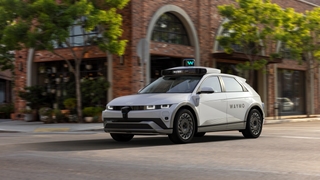
– The technology is mature and ready for widespread adoption. Waymo plans to launch a commercial service in London in 2026, Pony.ai is set to test Level 4 autonomous vans in Luxembourg, and WeRide is already operating in Belgium, Spain and Switzerland.

From robot taxis to shared public transport services
However, rather than simply opening up the market to individual robot-taxi services—booked and used as an alternative to taxis or private hire vehicles—the European approach could differ from the Chinese or American models. Thomas Matagne therefore suggests implementing a strategy to develop an optimised public transport system, which would offer potential benefits.
Taking the example of a 30-km road used for commuting around the Nantes metropolitan area. Switching to a system of autonomous vehicles designed as public transport would reduce the number of vehicles on the road each day by a factor of four and save €4 billion a year. “In our simulation, which prioritises public transport over private transport, it is possible to increase the occupancy rate of autonomous vehicles and thus maximise their social benefits. Vehicle flows are no longer managed on a journey-by-journey basis for each passenger request, as in the ‘robotaxi’ model, but organised into public transport services (buses, trains, etc.),” summarises the report’s author.

Four key areas of development
In line with this thinking, a number of recommendations will form the basis for discussions among EU Member States:
– Prepare for the practical introduction of autonomous vehicles by developing transport services in poorly served suburban and rural areas. For example, build hubs to link up coach routes, car-sharing schemes and express networks, and create dedicated lanes or priority parking spaces for recharging
– To foster the emergence of two or three European leaders in autonomous driving, in order to secure both the technology and technological sovereignty. These companies will need substantial funding, in the form of both capital investment and public procurement contracts, to be able to compete with their American and Chinese counterparts.
– Invest in and take the lead on road operating system technology, including autonomous vehicles. It is, in fact, only through collective action that road mobility infrastructure can be established and managed.
– In France, identify five to ten pilot areas – encompassing urban, suburban and rural communities – where the large-scale deployment of autonomous vehicles would be authorised, financially supported by the State and fully integrated into the local transport system, from 2026 onwards. The aim would be to focus efforts on ambitious, system-wide projects.

Take the initiative again
Given the speed at which start-ups in Silicon Valley and Chinese firms are rolling out their technologies, Europe’s lag in the development of autonomous vehicles is very real, but not insurmountable. The role of local players is now to take the initiative, change habits, win people over, drive progress and develop a European model for autonomous transport. The challenge is ambitious but not unrealistic, given that this technology is still in its infancy.