
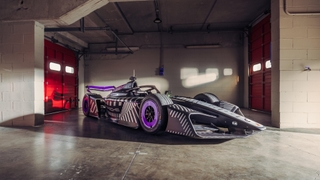

On 20 April 2026, Porsche became the first manufacturer to unveil its GEN4 Formula E single-seater. Named the 975 RSE, it brings to life the regulatory framework that the FIA and Formula E had unveiled in November 2025. With this reveal, the German brand has therefore become the technical benchmark for the upcoming 2026/27 Formula E season.

A name, a story
The first detail revealed by Porsche is its name. It features the number 9, which is clearly an obsession at Porsche, as following the 911, the 918, the 919 and the 99X Electric, the 975 RSE is no exception. The number 75 preceding the 9 didn’t come out of nowhere: as the press release tells us, it refers to the 75th anniversary of Porsche Motorsport, which takes place this year, in 2026.

GEN4: the biggest development in the history of the sport
Porsche and Formula E aren’t mincing their words. According to them, the GEN4 represents the biggest technical leap since the championship was launched in 2014.
In normal mode, the 975 RSE produces 450 kW, or 616 bhp. In Attack Mode – a tactical activation that drivers choose by cutting through a designated section of the track – it climbs to 600 kW, or 816 bhp. That’s 71% more peak power than the GEN3. As for top speed, it is expected to reach 335 km/h, and the 0 to 100 km/h sprint takes around 1.8 seconds. This is indeed what Florian Modlinger, Director of the Formula E works team, announced: “The races should become even more exciting, as the new cars are considerably faster. The acceleration is impressive, and we’re expecting top speeds of up to 335 km/h.”

Another new feature of this generation is the permanent all-wheel drive system, a first in terms of consistency across all phases of the race. Combined with significantly higher levels of downforce than the previous generation – up to 150% more than the GEN3 Evo – the car promises a radically different experience for the drivers. Faster, more physical, and more demanding to control under braking.
Aerodynamics: the major innovation of the GEN4 era
This is one of the most noticeable changes in this new generation. For the first time in Formula E, two distinct aerodynamic setups will be used depending on the situation: a high-downforce package for qualifying and a low-drag package optimised for the race. This significantly increases cornering speeds, as well as energy consumption.
Olivier Champenois, Technical Project Manager for Formula E at Porsche Motorsport, sums up this development well: “Over the past decade or so, Formula E has become so fast that downforce is now essential. However, downforce inevitably generates drag and increases energy consumption.”

A machine that recovers as much energy as it consumes
But the big news of the day is undoubtedly the new Porsche, so let’s talk a bit about it. In terms of energy, the 975 RSE’s energy recovery system can reach 700 kW during braking, with between 40 and 50 per cent of the propulsion energy coming from regenerative braking. Electric braking alone can deliver up to 350 kW across both axles. The battery, standardised by the championship, is a lithium-ion battery with a usable capacity of 51.25 kWh.

Thomas Laudenbach, Vice-President of Porsche Motorsport, likes to point out that the sport and the cars involved are constantly evolving: “In 2014, drivers had to change cars mid-race because a single battery wasn’t enough to cover the full distance. Twelve years later, the GEN4 is approaching the performance level of a Formula 2 car. The progress made has been staggering.”

A team in a strong position
Porsche is not entering the GEN4 era as an underdog. As the manufacturer points out in its press release dated 20 April 2026, the 99X Electric, the current 100% electric single-seater in competition, has won four world titles. It is therefore logical to expect a transition to GEN4 with the aim of maintaining strong sporting continuity, with engineers who have mastered the discipline and a team that knows how to win.

However, this may not be the final version of this single-seater. Porsche has until October 2026 to finalise the hardware development before moving on to the software optimisation phase. FIA homologation is scheduled for the autumn, and the car is expected to make its racing debut in December 2026, at the official launch of the 2026/27 season.
In the meantime, Porsche’s two works drivers, Nico Müller and Pascal Wehrlein, seem impressed by it: “The new Porsche 975 RSE is a truly brilliant racing car; I think it’s going to wow a lot of fans and critics. I also like the way it looks; the aerodynamics give the car a no-nonsense look, and our livery for the tests is rather striking.” “I’m glad I was involved in the simulator work right from the start.”


Formula E is entering a new era
With GEN4, Formula E is entering a whole new dimension. Faster, more powerful, more demanding to drive, and still true to the championship’s sustainable ethos. The FIA has designed this generation with a circular economy approach in mind: 100% recyclable materials, at least 20% recycled content, and ethically sourced components.
The 975 RSE is the first tangible manifestation of this revolution. It hasn’t taken to the starting grid yet, but it looks ready to tear down the track at full speed, and it heralds an exceptional 2026/27 Formula E season.