
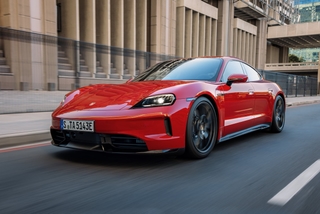


With sales of its flagship electric model on the decline, Porsche is updating the Taycan for its 2027 model year. The sports saloon now boasts a range of up to 700 km, features a virtual ‘gear-changing’ system and a new, more immersive sound. With more refinements than major technological overhauls, the aim is to reposition the Taycan as a car that meets the expectations of Porsche’s loyal customers: to deliver an emotional driving experience. This is a strategy that has become essential in the face of increased competition.

The Taycan makes a comeback
Following a successful market launch between 2020 and 2023, the Porsche Taycan is going through a difficult period. Global sales totalled just 16,300 units in 2025, compared with 84,000 Macans or 50,000 911 coupés. This decline can be explained by the fact that buyers of this type of luxury saloon remain loyal to internal combustion or hybrid engines, which offer a more engaging driving experience and remain practical for long-distance travel. To compensate for these shortcomings, Porsche promises a more immersive driving experience in the 2027 Taycan. However, the changes are more strategic than technical.

Virtual ‘gear changes’
The main new feature (already fitted as standard on the Turbo GT, the top-of-the-range model) is the introduction of an ‘e-shift’ option across the entire Taycan range. The electric sports car artificially recreates the sensation of gear changes, which are much appreciated in combustion-engine models. Put simply, the car simulates up to eight gear ratios; the driver can use the paddles on the Sport GT steering wheel and will feel slight jerks thanks to electronic control: engine braking when downshifting and a virtual rev limiter enhance this immersive experience. To enhance the auditory experience, Porsche has paired this ‘e-shift’ with a new interpretation of the Electric Sport Sound. The sound emitted both inside and outside the car varies according to the charge level and virtual engine speed. The driver can also view a rev counter and a gear indicator displayed on the digital instrument cluster.

Performance Pack
Still regarded as the benchmark for high-performance electric saloons, the Taycan will be able to showcase its dynamic capabilities thanks to the arrival of the Manthey kit, designed specifically for electric vehicles. The German tuning firm, which already equips numerous variants of the 911 GT and GT RS, has developed a bespoke kit comprising aerodynamic modifications, chassis optimisations and engine tuning to enhance track performance. The recent record set on the Nürburgring’s Nordschleife (6’55’’533, a record for high-performance EVs) attests to the benefits of this kit, which can be fitted as standard at the factory, but only on the most extreme version of the Taycan: the Turbo GT fitted with the Weissach package.

The symbolic 700 km WLTP mark
Another key factor in winning over potential customers is efficiency. The symbolic 700 km WLTP range mark has been reached. Whilst Porsche has not made any changes to the Performance Plus battery (the one with the highest capacity) or the motor, it has fitted tyres with very low rolling resistance, which add an extra 20 km to the range on a single charge. These 20-inch ‘summer’ tyres are designed for long journeys and are available on the rear-wheel-drive versions of the Taycan saloon and Sport Turismo.

Faced with competition from Asian models, which are highly advanced in terms of software, Porsche has also modernised its multimedia system, making it faster (with five times the computing power) and more intuitive; it is operated just like a smartphone, with simplified graphics and an enhanced digital ecosystem. The voice assistant incorporates artificial intelligence to streamline internet searches and locate points of interest… The charging flap can now be opened by voice command. The wireless smartphone charging pads deliver up to 25W of power.

Catching up with Chinese competitors
This major update therefore feels more like a necessary step up in class than a complete overhaul of the electric model, whose dynamic handling remains among the most effective and high-performing on the market. But we must save the Taycan and enable it to deliver that quintessential Porsche driving experience. Whilst it dominated the premium electric car segment at its launch, there are now numerous competitors that are more technologically advanced and cheaper, such as the Xiaomi SU7, which delivers impressive performance at a price well below that of a Taycan, whose starting price is €106,500.