
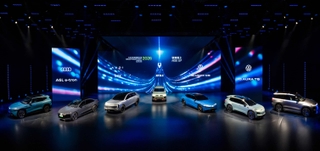


I had the opportunity to visit the 2026 Beijing Motor Show. It was my fourth trip to China in two years, a period during which the scale of its industry has been surpassed by the speed of its development. The show, held in April, once again demonstrated the strength of the Chinese, proving that their strength lies not only in their impressive production and sales volumes, but also in their ability to innovate and anticipate trends.

That’s what impressed me most about this exhibition. Of course, the figures
were simply incredible: across 380,000 square metres of exhibition space and 1.3
Spanning a kilometre between the south and north sections of the conference centre, 1,451 vehicles were on display, most of them from 82 different brands, including 60 Chinese and 22 foreign ones. Notable absentees included Kia, Chevrolet and Land Rover.
The most striking thing was the speed at which everything is changing. From the venue itself — whose exhibition space has doubled in just two years — to the number of new brands and models, not to mention the technological advances and mobility solutions on display, the automotive industry has undergone major transformations throughout its history, such as the meteoric rise of Japanese manufacturers in the 1970s and 1980s, or the rapid growth of Korean brands in the 1990s and 2000s. But never before has the automotive industry experienced changes as rapid as those currently being experienced by Chinese manufacturers. And this is perhaps the greatest challenge now facing traditional car manufacturers.
The motor show provided an opportunity to unveil 38 new production vehicles. Eight of these were presented by foreign manufacturers (five by the Volkswagen Group). With the exception of the
Porsche Cayenne Coupé: all these models have been designed by and for the Chinese market.
In other words, the epicentre of the global automotive industry and its latest innovations is no longer Europe, the United States or Japan, but China. What happened in Beijing reflects a trend that has been emerging over the past few months.
Based on my monitoring of new models, between January and May this year, Chinese manufacturers launched an average of two new models per week. That is twice as many as European brands during the same period.
The West, Japan and Korea have never experienced such a pace. Consequently, they are not accustomed to such rapid product development cycles.
Western arrogance is a thing of the past.
The traditional car manufacturers, once the undisputed leaders of the industry, are now mere spectators. This was the atmosphere at the stands of brands such as Volkswagen, BMW, Mercedes, Toyota, Hyundai, Nissan, Audi, Ford, Honda, Mazda and Buick.
Media and public attention is now focused on the statements and presentations made by Chinese figures.
And when foreign brands launch a new model, it is often a product steeped in Chinese DNA. This is the case with Audi, the Volkswagen ID range, the Nissan N range, the Ford Bronco EV, almost all new Buick models, the Hyundai IONIQ V, the latest Toyota bZ models and Mazda electric vehicles.
Gone are the days when top European and American executives used to arrive at motor shows like demigods. Today, they come across, at best, as mere executives trying to understand how Chinese manufacturers manage to offer innovative solutions without driving up the final price of the vehicle.
It may well be this arrogant attitude that clouded the judgement of many of these companies. They underestimated their Chinese competitors and, although they had anticipated the arrival of electric vehicles (Renault Zoe, Nissan Leaf, BMW i3, Chevrolet Volt), they never imagined that the transition — at least in China — would happen so quickly.
Consequently, the sector’s most important decisions are no longer taken at
Detroit, Wolfsburg or Tokyo – but in China. Electric vehicles now have a name, and if it isn’t Tesla, there’s a good chance it’s a Chinese brand. And this phenomenon is no longer confined to China; this trend is gathering pace in emerging markets (Latin America, South-East Asia, Africa, Russia and Central Asia), as well as in many developed regions (Australia, Europe and the Middle East).
The problem for Western manufacturers is no longer just their freefall into the
the world’s largest market. Having seen their market share in China fall from 63–66% before the pandemic to 32–36% today, traditional car manufacturers now find their once-strong position outside China under threat as well.

It’s not just a question of price
China’s rise cannot be explained solely by competitive pricing. At a motor show such as the one in Beijing, it was the models from Chinese brands that wowed visitors the moment they walked in. The perceived high quality of the materials, combined with state-of-the-art infotainment systems and a wide range of accessories and solutions, makes the
a truly enjoyable experience on board.
Although many of these gadgets are not popular in the West (who needs an in-car karaoke system?), the reality is that this is how today’s consumers are won over. This ability to surprise has been lost in the West, where cars are not only more expensive, but also more bland and simplistic. The contrast was striking between the enthusiasm of those in an Xpeng and the lukewarm reaction of those getting into a Mercedes.

A geopolitical issue
The motor show also reflected the new balance of power between China and developing countries. It is interesting to note how the Chinese invite thousands of journalists from developing countries where they wish to expand their influence. They treat them with deference and lead them to believe that the Chinese car is the car of the moment.
When have Western manufacturers ever shown such consideration, given that they often tend to look down on developing countries by offering them less sophisticated vehicles that fall short of safety standards? Clearly, China’s public relations efforts are bearing fruit: just as in their domestic market, Chinese vehicles are now becoming more attractive than Western ones in many developing countries.