

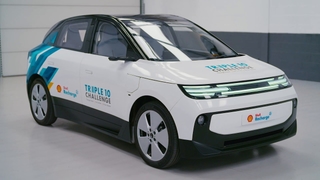

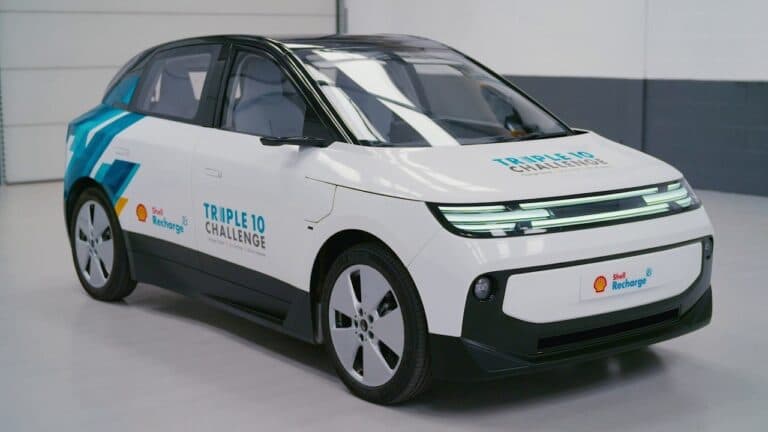



The ‘Triple 10 Challenge’ concept car, devised by oil company Shell, represents an interesting vision for the future of electric cars. This technology demonstrator pushes the boundaries of battery technology by combining ultra-fast charging, high energy efficiency and a reduced carbon footprint over the entire life cycle. The secret lies in a new approach to battery thermal management.

Developing new fluids for cooling batteries
Unsurprisingly, the Anglo-Dutch oil company Shell is investing more and more in research into lubricants and technologies for electric vehicles. Already operating a large network of charging points (through the acquisition of specialist operators) via Shell Recharge, the company is also forging partnerships with battery manufacturers and equipment suppliers. The aim is to develop new battery coolants and fluids – a major challenge for the industry – and to simplify their use.
In this context, the ‘Triple 10 Challenge’ project recently unveiled by Shell is based on three challenges: achieving a charging time of less than 10 minutes, energy efficiency of 10 km per kWh consumed, and limiting CO₂ emissions to 10 tonnes over the vehicle’s entire life cycle. This concept car takes the form of a B-segment SUV, a very popular model in our markets, which offers numerous advantages: light weight, agility and a lower purchase price.

A new approach to thermal management
At the heart of the project, Shell has developed a dielectric thermal fluid that absorbs the heat emitted by the battery cells (a factor that limits charging power). Unlike traditional systems using a mixture of water and ethylene glycol, this technology enables direct immersion cooling not only of the battery, but also of the electric motor and power electronics. This ‘Triple 10 Challenge’ car is therefore the first road-legal vehicle to demonstrate the potential of a single-loop cooling architecture, capable of effectively managing the temperature of the entire powertrain, even during fast-charging phases under extreme conditions.
Advantages: this type of cooling system helps to reduce the vehicle’s weight, improves its fuel efficiency and simplifies its mass production, as the technologies are already available.

Charges from 10% to 80% in under ten minutes
In practical terms, the vehicle is capable of charging from 10% to 80% in 9 minutes and 54 seconds at a 175 kW public charging point – a power rating that is fairly common amongst the fast-charging options currently available. This performance would enable the vehicle to regain up to 245 kilometres of range on a single charge, thanks in particular to a more compact battery and the use of these thermal fluids. Compared to a conventional EV, this technology delivers five times more range per minute of charging. These figures are close to the ultra-fast charging performance recently demonstrated by Chinese manufacturers BYD and Zeekr.
In this case, Shell aims to show that having a ‘low-capacity’ battery that needs to be charged quickly and frequently would no longer be such a constraint.

Carbon footprint halved
As well as charging speed, Shell is highlighting the environmental benefits of its concept car. Thanks to a lower-capacity battery, a simplified cooling system and the use of lightweight, recycled components, the vehicle has a carbon footprint of 10 tonnes of CO₂ over its entire life cycle – around 50 per cent less than that of comparable electric vehicles currently on the market.

Improved energy efficiency
Finally, this concept car can achieve a fuel efficiency of 10 km/kWh; in other words, it improves efficiency by 30 per cent compared with current-generation electric cars. For Shell, this approach demonstrates that it is possible to improve overall performance without resorting to ever-larger batteries.

Technology designed for industry
This prototype therefore runs counter to the current trend of continually increasing battery size to improve the range and performance of electric vehicles. Not only will the integration of these coolants reduce the electric car’s overall weight, but it will also improve its manoeuvrability and fuel efficiency, whilst reducing the amount of raw materials and resources required for mass production. Shell has announced that this architecture is compatible with future models intended for the general public.
The value of this demonstrator thus shows that innovations in the electrification of the vehicle fleet do not always involve an ever-increasing use of materials (more cells, greater capacity or complex chemistry for energy storage) but that focusing on components such as fluids can play a major role in the development of electric cars in the near future.