


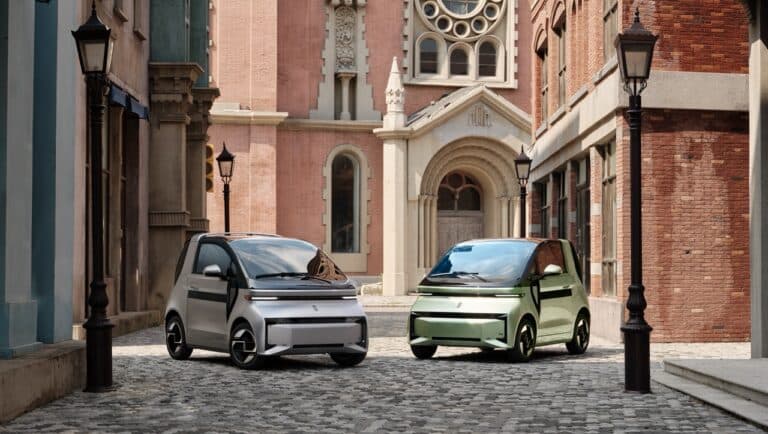

A new brand from China is launching in France this summer: Linktour. Its electric quadricycle is designed to be more comfortable, more spacious and more technologically advanced. Put simply, the Alumi aims to replicate the driving experience of a conventional car. It’s an ambitious challenge, but the public could well be won over by this licence-free microcar as it goes head-to-head with Stellantis’s star models, the Citroën AMI and the Fiat Topolino.

Micro-city cars: a booming category
The micro-city car segment has seen a spectacular surge in popularity in recent years, driven by the Stellantis duo: the Citroën AMI and the Fiat Topolino. For these light quadricycles (L6e category, ‘licence-free cars’), the European market has grown from 27,000 registrations in 2019 to nearly 64,000 in 2024 (+137% over five years). The same trend is evident in France, where the market has more than doubled over the same period (29,000 units sold in 2024).

It is electrification, in particular, that has fuelled this boom: three-quarters of the models sold are electric. These small, licence-free cars are a hit with young people, who can get behind the wheel from the age of 14. But there is considerable potential for growth: car-sharing, a second car for urban households, and vehicles for older people or in areas poorly served by public transport.

Moving upmarket
Having started out as a niche segment, micro-city cars are therefore set to become a mobility solution that meets people’s expectations and lifestyles, provided they remain affordable. Faced with the dominance of models from Citroën, Fiat and Microlino, a new brand from China is attempting to establish itself in France this summer: the Alumi from Linktour. This microcity car, classified as L6e (no licence required) or L7e (B1 licence required), aims to offer a step up in terms of design, comfort and technology. Eco Motors News put the L6e Alumi Pro version, with its mid-range specification, through its paces.

Innovative design
The highly geometric design of this micro-city car boasts an original style with a touch of avant-garde flair in its lighting signature (LED daytime running lights and rear lights) and 13- or 14-inch alloy wheels. Its cubic shape catches the eye and intrigues passers-by. The body colours range from Moon White to Boreal Green, Starry Black and Rock Grey. These colours are more understated than its futuristic look.

A warm welcome
The first impression comes from opening the door, which feels surprisingly heavy and solid. You’re getting into a proper car, unlike those micro-city cars whose plastic bodywork feels a bit too flimsy. The Alumi’s bodywork is made entirely of aluminium, and the panoramic roof (fitted as standard) creates a lovely, airy feel. The driving position is comfortable and the dashboard layout is simple yet ergonomic. The touchscreen (which is a little slow) allows you to control the air conditioning, the radio and Apple CarPlay or Android Auto apps (which can be connected wirelessly).

Behind the steering wheel, an instrument cluster displays essential driving information (speed, remaining range, etc.). Whilst the quality of the materials on board remains rather basic, with a predominance of hard plastics, the overall design is cohesive, well-designed and well-equipped (USB-C socket, storage compartment beneath the windscreen, fabric seat upholstery), which sets it apart from the very stripped-back rival models. It is worth noting the boot capacity (320 L), which is large enough to accommodate two cabin-sized suitcases and the charging cable (2 kW via a domestic socket or public charging point).

A reassuring chassis
A quick spin around Paris confirms that initial visual impression. The Alumi handles like a proper small car, with a rigid and reassuring chassis that minimises body roll. This chassis incorporates the 7.2 kWh LFP battery directly (giving a range of 120 km). Naturally very light (95 kg), this aluminium cell-to-body architecture enhances the structure’s impact resistance and boosts acceleration by 12 per cent. Weight distribution is well balanced at 50-50 between the front and rear.

Easy to manoeuvre
With its top speed limited to 45 km/h, the Alumi accelerates quietly and without much responsiveness (65 Nm of torque, 6 kW of rated power), and brakes adequately. The suspension does little to dampen vibrations from Parisian cobblestones, and bumps in the tarmac are felt through the seat, which is rather unpleasant in everyday use. However, the micro-city car makes up for this with its manoeuvrability and ease at weaving through traffic, even without power steering. On the other hand, three-quarter rear visibility is its weak point: a small rear quarter window in place of the body panel would be welcome. When it comes to U-turns and parallel parking, the Alumi (2.68m long) is in its element, aided by a reversing camera.

A relaxed driving experience
Unlike the Citroën AMI or Fiat Topolino, the Linktour Alumi offers a more relaxed driving experience, a greater sense of safety on board and a higher standard of equipment. It is also more expensive than its Stellantis counterparts. Expect to pay from €10,690 for the basic Alumi (with a 3-year warranty on the vehicle and a 5-year warranty on the motor and battery), whilst a Citroën AMI starts at €8,400. Modelabs, the company distributing the Linktour for the French market, is aiming for nearly 3,000 annual sales from 2027 onwards, and is currently developing its dealer network across France.
It is worth noting that an Elite version of the Alumi is available in the L7e category, meaning it is open to holders of a B1 licence aged 16 and over. It has a top speed of 90 km/h, a longer range (180 km) and a rated power output of 10 kW. Its price ranges from €14,990 to €17,389 depending on the options chosen. But at these prices, wouldn’t it make more sense to opt for genuine electric city cars that are just as affordable, such as the Dacia Spring, Citroën ë-C3 or Fiat Panda?

Technical Specifications:
Linktour Alumi
Category: L6e (motorised quadricycle, no licence required, from 14 years of age)
Range: 120 km (WMTC standard)
Battery: 7.2 kWh
LFP Motor power: 6 kW Maximum power: 12 kW
Torque: 65 Nm
Maximum speed: 45 km/h
Charging mode: AC (alternating current) Charging power: 2 kW (via domestic socket or charging point)
Charging time: 4 hours
Length: 2.68 m
Width: 1.50 m
Height: 1.55 m
Wheelbase: 1.80 m