


Lotus, the legendary British brand founded by engineer Colin Chapman, has been going through a rough patch for several years. On the brink of bankruptcy, the manufacturer was taken over by the Chinese giant Geely. This takeover gave rise to a new strategy focused on high-performance electric vehicles, with the imposing Eletre SUV serving as its flagship model since 2023. Eco Motors News got behind the wheel of its most radical variant: the Eletre 900 SC (for Sport Carbon), with 918 ch and a 0-100 time of under 3 s!

A pioneer amongst electric super-SUVs
For motoring enthusiasts, combining the terms ‘electric’ and ‘SUV’ seems like a far-fetched and incompatible concept. And if this is happening at Lotus, the brand founded by engineer Colin Chapman (and his famous motto: ‘Light is right’ – meaning, ‘The less weight, the better the performance’) – then the Eletre 900 SC seems like an anachronism. Can an electric SUV be a super sports car? That’s the challenge Lotus, now under Chinese ownership, has set itself. When it was launched in 2023, the Eletre faced competition from the Tesla Model X and the BMW iX M60 in this niche market for electric super-SUVs. It has now been joined by the more luxurious electric Porsche Cayenne.

The most powerful production Lotus, excluding hypercars
The technical specifications for the Eletre 900 SC leave no room for doubt: a kerb weight of 2,700 kg, 918 ch of power delivered to the permanent four-wheel drive system, a wheelbase of over 3 m and a ground clearance of over 18 cm with the battery pack housed in the floor, which results in a fairly high centre of gravity for a supercar.
In short, the Eletre 900 SC is the largest and most powerful Lotus in the manufacturer’s history, with the exception of the Evija hypercar. Nevertheless, does the Eletre deliver a driving experience worthy of its prestigious predecessors and of Lotus’s reputation?

Shaped by air currents
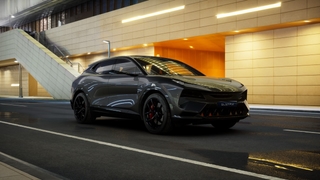
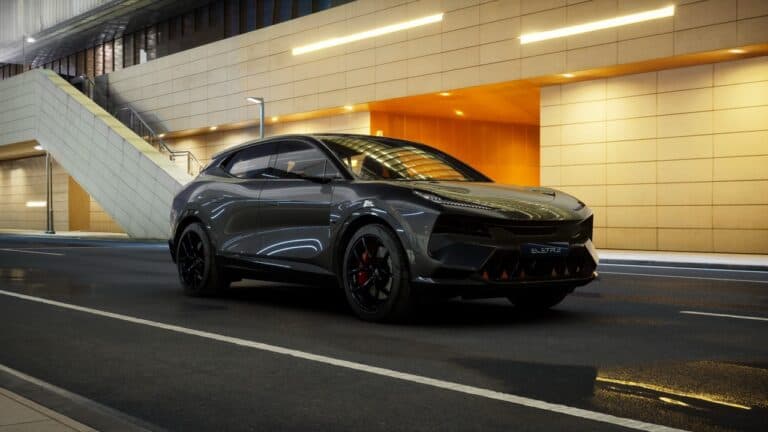
Visually, it certainly doesn’t go unnoticed. It is 5.10 m long, 2.23 m wide (including the camera-based wing mirrors) but quite stocky, with a height of just 1.63 m at the roofline. The styling is imposing, but the lines are sculpted by meticulous aerodynamic engineering (a drag coefficient of 0.26), revealing air intakes that run from the bonnet to the raked windscreen and around the wheel arches. These recesses, which channel up to seven airflows, not only give the car a supercar-inspired look but also enable more effective cooling of both the batteries and the brakes. These aerodynamic details are also found at the rear, which features a split rear spoiler and a dynamic wing that deploys from 110 km/h, in a high-stability position, and stands vertically to act as an air brake.
The Eletre features a refined look with LED headlights, whilst at the rear, a full-width light strip enhances its dynamic appearance. Whilst it certainly has plenty of character, it is difficult to recognise it as a Lotus at first glance.
Among the design highlights are the numerous carbon fibre inserts, which emphasise the Eletre’s sporty character, as does the active grille, which opens to cool the components and reduce drag: it is shaped… like a lotus flower.

The welcome on board meets the standards of luxury
Paradoxically, the Eletre is imposing yet manoeuvres easily through the streets of Paris, aided by its multiple cameras which provide a 360° panoramic view. The radar, sensors and lidar fitted to the car display the surrounding traffic conditions on the central screen. You can clearly see other road users in real time, whether they are cars or two-wheelers. It’s useful and reassuring.
Lotus has opted to replace the traditional wing mirrors with discreet, more streamlined cameras; however, the display screens are positioned too low for the driver’s line of sight and may obstruct visibility.
Designed as a highly immersive, driver-focused cockpit, the driver’s seat is ideal and easy to get to grips with. The interface is ergonomic, clear and fairly intuitive. The AI-enhanced infotainment system requires no learning curve. On the huge 15.1-inch central OLED screen, apps glide beneath your finger – it’s quick and as simple as using your smartphone.
The interior design is in keeping with the standards of luxury cars: leather, Alcantara, carbon fibre trim and a high-quality feel. With few physical controls, Lotus has opted for refinement. The steering wheel and its large paddles (for engaging regenerative braking or selecting the driving mode) exude a sense of competition and technology. Without a doubt, the Eletre ranks amongst the very best high-end sports SUVs, alongside the Bentley Bentayga and the Lamborghini Urus.
The Lotus SUV can comfortably seat five people. The boot is also very spacious (688 L capacity), and there is also a small 46 L ‘frunk’ under the bonnet at the front.

Adaptive suspension and a smooth ride
Behind the wheel, you’ll appreciate the precision and responsiveness of its chassis. The adaptive suspension and active anti-roll control work in tandem with torque vectoring during braking. The whole system is seamlessly integrated, ensuring a comfortable ride and excellent handling on the road. For the driver, the rear-wheel steering is a real treat, offering improved manoeuvrability in this imposing car. These technologies enhance the driving experience, which is designed to be responsive but can also be quite relaxed in ‘Tour’ mode – the most comfortable road setting.

Lotus’s sporting DNA remains intact
Lotus Cars has been owned by the Chinese group Geely since 2017, which also owns Volvo and Polestar. Indeed, the Eletre is the technical cousin of the Polestar 3 SUV, but it retains more sporting characteristics, in keeping with Lotus’s heritage. The Eletre 900 SC (Sport Carbon) is thus equipped with two high-performance electric motors (one per axle) delivering 675 kW of power, or a combined 918 ch. The all-wheel-drive system has two gears, the change between which is imperceptible in use. Acceleration torque stands at 985 Nm. That’s enough to push you back into your seat every time you press the right-hand pedal. In ‘Track’ mode – the most extreme setting – an unprepared passenger could almost be thrown forward like a whiplash injury. Yes, for all its size as a large SUV, the Eletre is a lively and hyper-responsive electric vehicle. This vitality makes up for its bulk and puts a smile on the driver’s face.
It goes from 0 to 100 km/h in 2.95 seconds, which is quite a feat for such a heavyweight. Better still, it accelerates strongly on the motorway, going from 80 to 120 km/h in under 2 seconds. You’d hardly notice its total weight (which can exceed 3 tonnes with passengers and luggage). Its electronically limited top speed is 296 km/h.

Range of 450 km
Unfortunately, this performance is likely to be short-lived, judging by the energy gauge, which is dropping rapidly as a result of these bursts of power. With a claimed range of 450 km, it will be difficult to cover more than 300 km when driving dynamically. The batteries are lithium-ion, with a capacity of 112 kWh, and thanks to its 800 V architecture, the Eletre can support charging powers of up to 350 kW DC. This means it can go from 10% to 80% charge in 20 minutes. In this respect, Lotus does not outperform its rivals, the Tesla Model X or the electric Porsche Cayenne.

From €101,590
In its most powerful and exclusive 900 SC version, the Eletre therefore offers genuine pleasure in terms of comfort and driving enjoyment, and takes you to high speeds with ease. Even when the road becomes more winding, the electronic steering and dynamic chassis make up for any over-enthusiastic manoeuvres.
Whilst the handling of the electric power may live up to the expectations of regular Lotus buyers, customers are not yet flocking to dealerships. Is this because of its exorbitant price? Priced from €163,090 for the 900 SC version, our test model costs over €171,910 including VAT. This is very expensive compared to the V8-powered super-SUVs currently on the market. Overall, the uptake of electric vehicles by potential buyers in the ultra-luxury segment is not keeping pace with the investments made by the brands.

Eletre Hybrid X, the 952 ch plug-in hybrid
Due to a lack of orders, Lotus is adjusting its plans. It has therefore just added a new model to its range: a plug-in hybrid version of the Eletre (with a range of 350 km in electric mode and 1,200 km in combined mode). Dubbed the Hybrid X, it features a 2.0-litre four-cylinder petrol engine and a 70kWh battery, making it the most powerful Eletre model with a combined output of 952 ch and a 0 to 100 km/h time of 3.3 s. Whilst this partial return to internal combustion may appeal to some Lotus enthusiasts, it remains to be seen whether it will be enough to secure the Eletre’s place amongst the most memorable super-SUVs of its era.
Notes:
Battery life: 3.5/5
Driving experience: 4/5
Versatility: 3/5
Comfort: 4/5
Technology: 4/5
Technical specifications:
Lotus Eletre 900 SC (112 kWh)
Power: 918 ch
Torque: 985 Nm
Range: 450 km
Charging time from 10% to 80%: 20 mins (350 kW DC)
0–100 km/h: 2.9 s
Top speed: 296 km/h
Boot capacity: 688 L + 49 L (front)
Price of the model tested: €171,910
Prices for the Eletre SUV range: from €101,590