


To consolidate its position in a rapidly changing automotive world, Lotus, the British brand now owned by the Chinese manufacturer Geely, is reorienting its strategy. Having previously focused heavily on electric vehicles, the “Focus 2030” plan marks a return to internal combustion engines through hybridisation. A prestige supercar with an electrified V8 engine is expected to be launched in two years’ time.

Performance-oriented cars
Lotus is adjusting its plans to address global challenges and maintain its competitiveness. As a reminder, the British brand was founded in 1952 by the ‘rebellious spirit’ Colin Chapman, the man behind the philosophy: ‘light is right’ – in other words, ‘the lighter the car, the better its performance’. True to this philosophy, Lotus has made a name for itself in Formula 1 and has always designed sporty, agile and sensational cars for its customers (Esprit, Elan, Elise…).
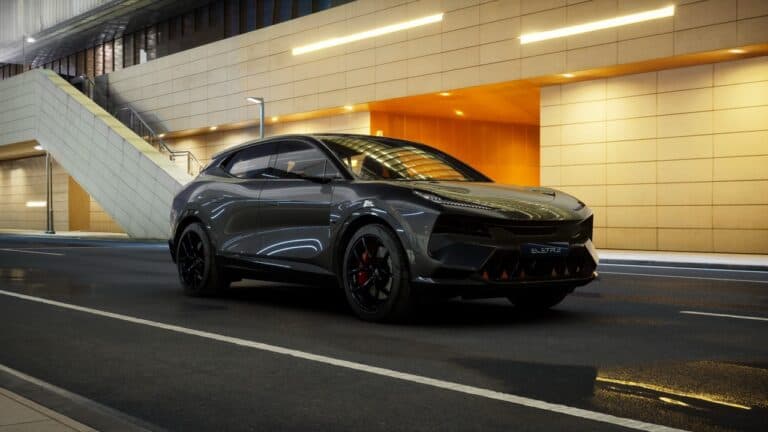
In 2017, the Chinese giant Geely acquired the ‘small’ British carmaker, whose sluggish sales were threatening its survival. Today, the range includes three electrified models: the Emeya (GT), the Eletre (SUV) and the Evija (hypercar), but their sales remain fairly modest and are not enough to ensure the company’s survival in a globalised and rapidly changing automotive industry.

Multi-engine strategy
The ‘Focus 2030’ plan is therefore designed to strengthen the brand and relaunch a multi-powertrain strategy to meet customer expectations and adapt to the varying regulations across different regions of the world. In collaboration with its main shareholder, Geely Holding Group, Lotus is reorganising its technological development and manufacturing facilities. Lotus UK and Lotus Technology are expected to merge into a single entity in the near future.

Design in the UK, R&D in China
Ultimately, Lotus will continue to offer a flagship supercar with a 4-cylinder or V6 internal combustion engine (the Emira), but will primarily focus on PHEVs (plug-in hybrids) and BEVs (battery electric vehicles), aiming for a sales mix of 60% PHEVs and 40% BEVs.
In practical terms, design and engineering operations remain based in the UK, the brand’s birthplace and the foundation of its motorsport expertise, whilst R&D is managed from China to drive innovation and enable a faster ramp-up in the markets.

X-Hybrid, with a range of up to 1,200 km
The first example of this new strategy will be the launch in Europe, in late 2026, of the X-Hybrid technology in the Eletre SUV, under the name Eletre X. This ‘super hybrid’ is based on a 900 V architecture, featuring a 952 hp electric motor (935 Nm of torque) and promises a range of 350 km in all-electric mode, and 1,200 km in total (without refuelling or recharging). The 70 kWh battery can be charged from 20% to 80% at a fast-charging station in 9 minutes. It accelerates from 0 to 100 km/h in 3.3 seconds. This technology has just been introduced on the Eletre “For Me” model sold in China, and over 1,000 pre-orders have been placed in a single month.

A supercar with a hybrid V8 engine in 2028
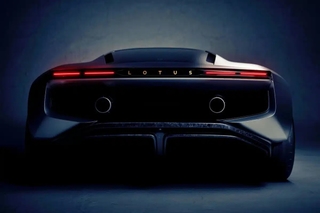
Furthermore, this multi-powertrain strategy marks a return to Lotus’s historic performance heritage. The next evolution of its hybrid technology will power a supercar, codenamed Type 135. This all-new supercar will be powered by a hybrid V8 engine developing over 1,000 hp, likely designed by Horse, a joint venture between Geely and Renault. It will be produced in Europe and is expected to launch in 2028. At this level of power, the rivals for this future Lotus include the Ferrari 849 Testarossa and the Aston Martin Valhalla, both of which are also hybrid supercars. Whilst fans of the brand may recall the legendary V8-powered Esprit, there is no indication that the future model will be its replacement. However, the Theory 1 concept unveiled in 2024 could serve as the design basis for this new hybrid GT coupé.

Target: 30,000 sales per year
In addition to this clearly defined product strategy, Focus 2030 also sets out commercial objectives to ensure Lotus’s long-term profitability: achieving stronger margins, offering greater customisation options for buyers, and scaling up to 30,000 annual sales as the range is completed. Driving pleasure, cutting-edge engineering and bold styling: the path forward is clear; all that remains is to realise these ambitions and bring Lotus back to the forefront.