
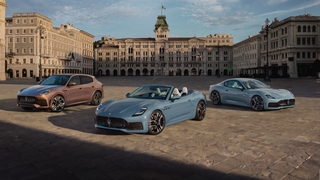


Although sales of the Italian brand remain very low, the facelift for Maserati’s three models includes the all-electric ‘Folgore’ variants. The Grecale SUV, the GranTurismo and the GranCabrio still deliver the same power outputs but now offer greater range. Could this be enough to revive interest in these cars, whilst we await the arrival of a V6 hybrid and the possible expansion of the range through a partnership?

Maserati in a sales slump
A paradoxical situation. Maserati’s range is, to say the least, appealing, but its cars are not selling well enough. Around 11,000 cars were sold in 2024, a 50 per cent drop on the previous year. This figure is insufficient for the Stellantis Group, which is reviewing its strategy, cutting back on investment and exploring new partnerships to save the Trident brand, though it is by no means abandoning electric vehicles.
The main indicator of this commercial crisis is the 100% electric Folgore range (which means ‘lightning’ in Italian). The premium brand was among the most ambitious in electrifying its flagship models, but customers have not followed suit, either in Europe or in the United States. Three Folgore models remain in the range: the Grecale SUV, the GranTurismo GT saloon and its convertible counterpart, the GranCabrio. However, the all-electric MC20 supercar has been cancelled for 2025 due to a lack of buyer interest.

Mid-career revamp
Today, Maserati is unveiling a facelift for its Folgore models (which are still powered by powerful petrol engines). These aesthetic updates mainly concern the front end, which now features a more angular design, with a redesigned bumper and side air intakes that appear to blend into the grille. At the rear of the GranTurismo and GranCabrio, there are few changes apart from the removal of the black trim strip.
Inside, the steering wheel on each model now features a flat-bottomed design, giving it a sportier look, whilst physical controls have been introduced amongst the screens on the centre console, improving ergonomics. The paddles behind the steering wheel now allow the driver to switch between forward and reverse gear, for example when manoeuvring into a parking space.

Electric motor ‘in standby mode’
Technically, the Grecale Folgore still delivers 550 ch, powered by three electric motors, the front one of which goes into standby mode when it is not required for traction. This helps to save energy, even though the WLTP range remains unchanged at 580 km. However, improvements to the management software have reduced the discrepancy with the range actually achieved in real-world use. The 105 kWh battery remains unchanged.

Longer battery life
The GranTurismo and the GranCabrio convertible retain their engines, which deliver 760 ch, and an 800 V, 92.5 kWh battery, but electronic optimisation has extended their range. The GT’s range has thus increased from 450 to 540 km (WLTP), whilst the GC’s range has increased by 61 km (from 447 to 508 km WLTP). Deliveries are due to begin in September.

Towards a hybrid V6?
These mid-life updates could therefore boost sales of these electric Maseratis, and whilst the brand has abandoned the idea of going fully electric by 2030, it is primarily planning to develop a conventional hybrid version of its V6 Nettuno engine. This engine, praised for its sound, would comply with the new European standards and help win over customers of these luxury models, who remain attached to the driving experience offered by internal combustion engines.
With this in mind, the brand is developing (with a partner?) two new E-segment models, which will be built on a multi-energy platform. This is because Stellantis now advocates ‘freedom of choice’ rather than forced electrification. It is a matter of survival in the face of an ever-increasing number of competitors.