
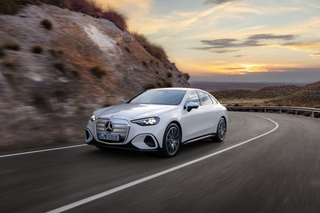


The electric Mercedes C-Class will be one of the star attractions at the upcoming Paris Motor Show (autumn 2026). It embodies the brand’s revival in the EV market, against a backdrop of growing competition from rivals such as BMW, Tesla and Chinese manufacturers
Objective: to modernise its image whilst remaining at the forefront of technological innovation, both on the road and on board

To become the brand’s best-selling electric model
Three months after winning the prestigious title of ‘Car of the Year 2026’ with the CLA, its compact four-door electric coupé, Mercedes-Benz has set its sights high with the launch of its new, fully electric C-Class. Historically, the C-Class has been the German manufacturer’s best-selling model (over 10 million units worldwide since 1982, including its predecessor, the 190). Its electric version must therefore also take on the role of best-seller. And success is by no means a foregone conclusion.
Having acknowledged the failure of the EQ range (nine EV models launched since 2016), Mercedes has overhauled its entire industrial electrification strategy by investing €2 billion in its European factories. Unlike the CLA, which is based on a multi-energy platform (MMA – Mercedes Modular Architecture), the technical platform for the electric C-Class is dedicated entirely to electric power (MBEA – Mercedes-Benz Electric Architecture), as is the case with the GLC SUV. Meanwhile, the petrol-powered C-Class remains in the range and will, in fact, be restyled next summer.

A Paris-Berlin journey with just one 10-minute ‘refuelling stop’
Manufactured in Kecskemét, Hungary, the electric C-Class measures 4.88 m (13 cm longer than the petrol-powered C-Class), giving it a generous wheelbase of nearly 3 m. Beneath the flat floor lies an NMC battery with a usable capacity of 94.5 kWh, enabling a range of up to 760 km under the WLTP cycle (pending certification). Thanks to its 800 V architecture, the C-Class will support charging powers of up to 330 kW, meaning it can recharge enough for 300 km in around ten minutes at a suitable DC charging point. Consequently, a journey from Paris to Berlin (1,054 km) can be completed with just one short stop. A compelling argument for the range of an electric car designed for long journeys.

489 hp, all-wheel drive
From its launch in late 2026, the sportiest version, the 400 4Matic, will go on sale: all-wheel drive, two motors (one on each axle), 489 hp and 0–100 km/h in 4.1 seconds. The gearbox has two ratios: the first is short for brisk acceleration and delivering torque in urban traffic; the second is longer to deliver power at high speeds, improving efficiency and range on the motorway. Optional features include rear-wheel steering and air suspension for an optimised and comfortable driving experience.

The Hyperscreen, the widest panoramic screen ever fitted to a Mercedes
In addition to its modern and elegant exterior styling (a grille featuring 1,050 light points, a sloping rear end and dynamic lines), screens are taking up an ever-increasing amount of space in Mercedes-Benz interiors. The C-Class is no exception. The latest generation of the 39.1-inch MBUX Hyperscreen, which spans the full width of the dashboard, is the largest screen ever fitted to a model from the brand. It is just as spectacular as the panoramic display featured in the EQS, the top-of-the-range model in the range.
To bring this digital dashboard to life, the MB.OS operating system developed by Mercedes features an MBUX virtual assistant equipped with generative AI, capable of handling sometimes complex conversations and providing assistance with navigation or information retrieval in challenging traffic conditions. The materials used throughout the interior (Nappa leather seats, door panels and dashboard) are entirely new. Mercedes is thus the first manufacturer in the world to offer an independently certified vegan interior.

Strategy for global (re)conquest, led by China
In Europe, as in the rest of the world, the electric C-Class will not only have to establish itself in the highly competitive premium saloon segment (Audi A4 e-tron, BMW i3 Neue Klasse, Tesla Model 3), but above all it will have to contend with the pressure exerted by Chinese brands in recent months. BYD, Nio and Peng offer highly technological models, equipped with high-performance interfaces, offering long ranges, high charging capacity and much more attractive prices.
Reflecting this profound upheaval, Mercedes’ sales in China are plummeting: down 19% in 2025, and already down 27% since the start of the year. Yet this market is becoming crucial to ensuring a model’s economic success (increasing volumes and maintaining healthy margins). However, like established car manufacturers, the German brand must also step up its development of next-generation batteries (LFP, energy density) and software expertise (OTA updates, a simpler user experience).
The price of this new C-Class has not yet been announced, but it is expected to be around €55,000 to €60,000 for the launch model, the 400 4MATIC, due at the end of the year.